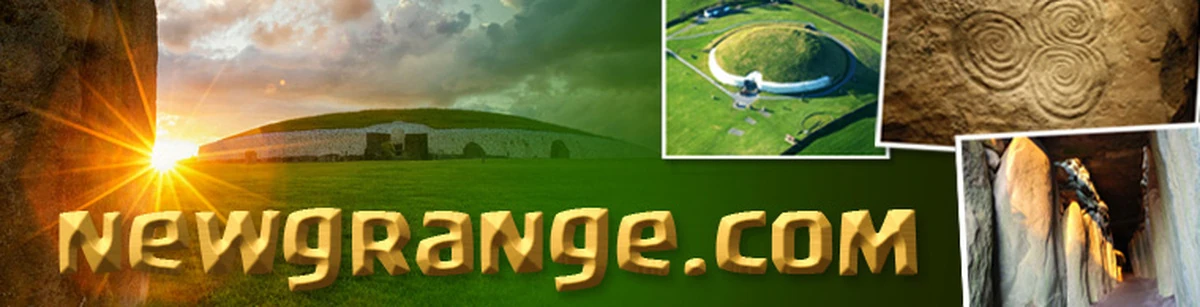
Newgrange
Newgrange
was constructed over 5,000 years ago (about 3,200 B.C.), making it older than
Stonehenge in England and
the Great Pyramid of Giza in Egypt.
Newgrange was built during the Neolithic or New Stone Age by a farming community
that prospered on the rich lands of the Boyne Valley.
Knowth and
Dowth are
similar mounds that together with Newgrange have been designated a World
Heritage Site by UNESCO.
Archaeologists classified Newgrange as a passage tomb, however Newgrange is now
recognised to be much more than a passage tomb. Ancient Temple
is a more fitting classification, a place of astrological, spiritual,
religious and ceremonial importance, much as present day cathedrals are places
of prestige and worship where dignitaries may be laid to rest.
Newgrange is a large kidney shaped mound covering an area of over one acre,
retained at the base by 97 kerbstones, some of which are richly decorated with
megalithic art. The 19 metre long inner passage leads to a cruciform chamber
with a corbelled roof. The amount of time and labour invested in construction of
Newgrange suggests a well-organized society with specialised groups responsible
for different aspects of construction.
Newgrange is part of a complex of monuments built along a bend of the River
Boyne known collectively as Brú na Bóinne. The other two principal monuments are
Knowth (the largest) and Dowth, but throughout the region there are as many as 35 smaller mounds.
Visitor Information
Access to Newgrange is only by guided tour from the Brú na Bóinne
Visitor Centre on the south side of the river Boyne. Newgrange is on the north side of
the river Boyne, visitors cross the river by pedestrian bridge and take a
shuttle bus to Newgrange. There is no direct public access to Newgrange by road,
except for the mornings around the Winter Solstice.
- Day Tours from Dublin and longer tours that include Newgrange.
Winter Solstice

Newgrange
is best known for the illumination of its passage and chamber by the
winter solstice sun.
Above the entrance to the passage at Newgrange there is a opening called a roof-box.
This baffling orifice held a great surprise for those who unearthed it.
Its purpose is to allow sunlight to penetrate the chamber on the shortest days
of the year, around December 21, the winter solstice.
At dawn, from December 19th to 23rd, a narrow beam of light penetrates the
roof-box and reaches the floor of the chamber, gradually extending to the
rear of the passage. As the sun rises higher, the beam widens within the
chamber so that the whole room becomes dramatically illuminated. This event
lasts for 17 minutes, beginning around 9am.
Newgrange's accuracy as a time-telling device is remarkable when one
considers that it was built 500 years before the Great Pyramids and more
than 1,000 years before Stonehenge. The intent of its builders was
undoubtedly to mark the beginning of the new year. In addition, it may have
served as a powerful symbol of the victory of life over death.
Each year the winter solstice event attracts much attention at Newgrange.
Many gather at the ancient tomb to wait for dawn, as people did 5,000 years
ago. So great is the demand to be one of the few inside the chamber during
the solstice that there is a free annual
lottery (application forms are
available at the Visitor Centre). Unfortunately, as with many Irish events
that depend upon sunshine, if the skies are overcast, there is not much to
be seen. Yet all agree that it is an extraordinary feeling to wait in the
darkness, as people did so long ago, for the longest night of the year to end.
Newgrange Resources

Boyne Valley Tours
Private Tours by Limousine or Eight Seater Minivan.
Pick up and return to your accommodation or cruise ship. Suggested
day tour: Brú na Bóinne Visitors Centre and Newgrange, the 10th century High Crosses and Round Tower
at Monasterboice, Hill of Tara the seat of the High Kings of Ireland, Bective Abbey and
Trim Castle the largest Anglo-Norman castle in Ireland.
More ...

|