
Slane Bypass Planning refused - Brú na Bóinne Heritage Sites
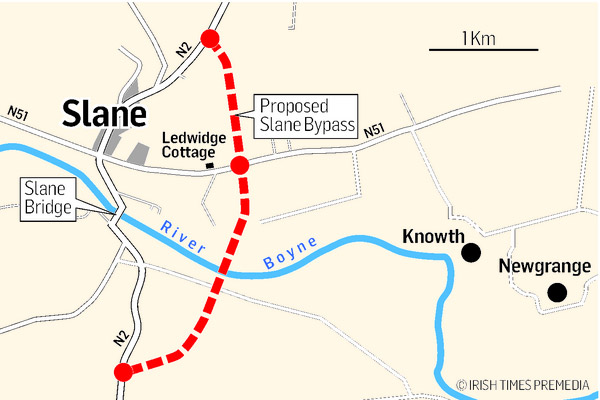
Planning refused - Irish Times report - 7th March 2012
by Tim O'Brien & Éanna Ó Caollaí, The Irish TimesResidents of Slane have said they are “shattered” and “devastated” following An Bord Pleanála's refusal to approve plans for a bypass of the Co Meath village.
Meath County Council had sought approval for a 3.5km route crossing the River Boyne on a new bridge between the townlands of Fennor and Crewbane east of the existing Slane bridge.
In its refusal, the board said the proposed bypass, which was to be located some 1.1km to the east of the existing N2 Boyne bridge, which is within the “viewshed” of the of the Brú na Bóinne Unesco world heritage site, “would be acceptable only where it has been demonstrated that no appropriate alternative is available”.
Campaign group Save Newgrange, which opposes the bypass, has called for a heavy goods vehicle (HGV) ban in the village, while the Slane Bridge Action Group and the Slane Bypass Group expressed scepticism that such a ban could be enforced. The village crossroads is a major junction of the N2, the main Dublin to Derry road, and of the main Drogheda to Slane road, the N51.
Minister for State and local Fine Gael TD Shane McEntee said planning for an alternative route for the bypass “that will get through the planning process a second time” should begin immediately.
However, the National Roads Authority (NRA) said the board's decision appeared to reject any proposed bypass of Slane and “is focused on a traffic management solution”. The authority said this was “disappointing especially for the people of Slane, but the NRA accepts the decision.”
The NRA was told last year to finish planning on all current road schemes and it does not have a budget to prepare a new route. Department of Transport sources said the decision, taken in the current economic context, effectively meant the bypass “will not be built in the next decade, at least”.
Meath County Council said it noted the decision with disappointment, but remained committed to finding a solution to the serious traffic and safety issues in Slane. “We will now examine the reasons for refusal and the report of the planning inspector and will work with the NRA to establish what further steps can be taken to address the issues raised by the Bord,” a spokeswoman added.
Speaking to The Irish Times, John Ryle of the Slane Bridge Action Group said the locals were “shattered and devastated” by the ruling. “We don't see why aesthetics, a view, should be take precedence over people's lives,” he said.
Mr Ryle said there were already extensive traffic calming measures in Slane and a 30km/h speed limit leading to the bridge, but nobody obeys it. “What respect does a runaway truck have for a speed limit whether it is 30km/h or 100km/h,” he asked.
Even if the ban worked, he said HGV traffic would simply divert through Navan or Drogheda rather than pay tolls on the M1 and M3 motorways.
He said some 22 people had been killed in crashes on the bridge, including two-year-old local toddler David Garvey and two people who died when their car exploded after a collision.
In another incident, a HGV failed to negotiate the sharp turn onto the bridge. It toppled over and slid along the parapet towards the centre of the bridge before tumbling into the river below, killing the driver. Two days later, the operator of the crane used to lift the wreckage from the riverbed died when the crane toppled into the river.
Mr Ryle said he believed there would be further crashes on the existing route in the absence of a bypass. Many more crashes went unreported because they were not fatal incidents, he said.
Slane Bridge Action Group spokeswoman Michelle Power also expressed regret at the decision. She said life in the village has been "overwhelmed" by the dangerous volumes of traffic. “We now feel that as we have exhausted every avenue open to us that we are now entirely helpless," she said. “The decades of inaction and failure to deal decisively with this appalling situation are nothing short of a national scandal.”
Ms Power, who survived a multiple pile-up on the bridge in 2009, said the planned route was outside the buffer zone around the Brú na Boinne and set in a valley. She said she believed the visual impact would have been acceptable in light of the loss of life on the road.
Save Newgrange spokesman Vincent Salafia welcomed the decision as "a huge victory for heritage and sustainable development in Ireland" and called for an "immediate" ban on HGV vehicles in the village. "The Unesco World Heritage Site is our most popular tourist attraction, which will play a key role in our economic recovery, and it deserves the highest level of legal protection,” he added.
An Taisce said An Bord Pleanála had made “an eminently logical decision and [which] has protected a very important piece of Irish National Heritage”.
Fianna Fáil Senator Thomas Byrne said this evening the decision was a "severe bodly blow" to the people of Slane.
"Meath County Council must meet immediately in order to gain approval for this request for a judicial review. My colleague, Cllr. Wayne Harding has already requested this in writing to the Cathaoirleach of the County Council and we await his reply,' he said.
Irish Times report - 24th February 2011.
by Richard McCullen, The Irish TimesThere is no immediate danger posed to the Brú na Bóinne site in Co Meath by plans to build a bypass of Slane village, according to a world heritage expert. However, Dr Douglas Comer warned the project would be another intrusion on the site and if there were others in the future, they could undermine its designation as a world heritage site of outstanding universal value.
Dr Comer was replying to questions from Gerry Browner, senior architect with the Department of the Environment, Heritage and Local Government, on the seventh day of an oral hearing by An Bord Pleanála into plans by Meath County Council for the bypass.
The proposed 3.5km dual carriageway, including a new bridge over the Boyne east of the village, would pass within 500 metres of a buffer zone around Brú na Bóinne which includes the ancient burial sites of Newgrange, Knowth and Dowth. Supporters of the project claim the bypass and bridge are urgently needed to improve safety for locals in Slane, which has been the scene of at least 22 fatal road crashes.
Opponents say the new road and bridge would have a detrimental effect on the local landscape, especially the archaeological sites. Dr Comer said some features already intruded into the site, such as the M1 motorway and Boyne bridge, the cement factory chimneys at Platin and the new Indaver incinerator at Carranstown, Duleek.
He said if the bypass got the go-ahead, Unesco's world heritage committee would likely send a fact-finding reactive monitoring mission to assess its impact on the Brú na Bóinne site. The committee might then decide there had been no deterioration to the site, place it on a list of endangered sites, or delist it. Mr Browner added that the department had already received a yellow card from Unesco over the incinerator.
Irish Times report - 23rd February 2011.
by Elaine Keogh, The Irish TimesMeath County Council has been accused of ignoring the magnitude of the findings of an international expert who says the Slane bypass could threaten the status of Brú na Bóinne as a Unesco world heritage site. Dr Douglas Comer had also said the proposed road breaches the council's own development plan, which says development must protect the amenity, views and landscape of the monuments in the world heritage site which includes Newgrange, Knowth and Dowth.
At the public hearing into the plans for the Slane bypass, Colm Mac Eochaidh SC, for former attorney general John Rogers who lives near the buffer zone for the world heritage site, asked whether they would be told if Dr Comer's report constituted “significant further information” and as such it should be advertised to the public.
Dr Comer said the landscape's heritage value was “as high as it gets” and the building of a road at or near a world heritage site was “the most problematic of all possible developments”. Of the effects of the proposed bypass, “none can be viewed as non-significant”. The council is seeking permission from the planning board to build a 3.5km dual carriageway at a cost of €46 million.
It retained Dr. Comer on advice from An Bord Pleanála to assess independently the heritage impact on the site of the proposed road. He had advised the hearing that “almost certainly,” there would be a visit by experts from Unesco asking about gaps in information on the proposed road.
The three likely outcomes of that process included being de-listed as a world heritage site. He said “nowhere else in the world” had the monuments and continuity of settlement that was found at Brú na Bóinne. Dr Comer also said he could not find any study on the implications of simply banning heavy goods vehicles from the village – proposed nearly two years ago – or a study on other alternatives to building the bypass. He added that the Boyne bridge on the M1 motorway was “without a doubt incompatible” with the landscape that led to Brú na Bóinne being inscribed by Unesco.
Irish Times report - 22nd February 2011.
by Elaine Keogh, The Irish TimesConstruction of the proposed Slane bypass in Co Meath could have implications for the world heritage status of Brú na Bóinne, the site that is home to the megalithic tombs of Newgrange, Knowth and Dowth, a planning hearing was told yesterday. An international expert on heritage sites said construction of the bypass was likely to result in Unesco “monitoring” the impact on the world heritage site.
Dr Douglas Comer told the An Bord Pleanála hearing that “failure to maintain the outstanding universal value of a world heritage site can threaten its status as such”. Meath County Council is seeking permission from the board to build the road and the oral hearing is expected to continue until early next month.
Dr Comer, an archaeologist and international expert on culture sites, said there could be “a very large adverse impact” on the site because of the proposed route of the road. He was asked by the council to prepare a heritage impact assessment of the road plan. He said “one might reasonably expect that the bypass will be seen as a further, incremental intrusion on the landscape”.
Dr Comer's report said that if assurances are given that the bypass will not stimulate new construction in the vicinity of the heritage site and if it is only visible from the top of Knowth, then it would represent a minor change with a moderate/large adverse effect.
However, without such assurances and if the road can be seen from several locations in the Brú na Bóinne site, then it would have a “large/very large adverse impact”, he concluded. The 3.5km dual carriageway would bypass Slane to the east of the village at a cost of €46 million and divert traffic from the village and Slane bridge where 22 people have died in traffic accidents in recent years.
Archaeologist Finola O'Carroll, who assessed the scheme for the council, said the new road would be visible from Knowth and Newgrange but the long-term impact of this was “in the visual and landscape assessment deemed respectively to be ‘medium and neutral' and ‘low and neutral'.” She said that the design of the bridge and the road seeks to minimise the visual disturbance in accordance with the principles of cultural heritage management.
Landscape architect Declan O'Leary said that to reduce the impact of the 200m long bridge, it is designed to sit within the existing topography. It will be 21m above the valley floor and made from a steel/concrete composite. Its crossing is set at a level to reduce the cutting into the valley sides, “limiting the impact on the Boyne valley”, he added.
Meath Archaeological and Historical Society Submission to Oral Hearing. More ...
Irish Times report - 19th February 2011.
by Elaine Keogh, The Irish TimesA cost-benefit analysis of the proposed Slane bypass found it represents good value for money, according to Meath Labour Senator Dominic Hannigan. Mr Hannigan was speaking in favour of the proposed 3.5km road at the Bord Pleanála public hearing into the scheme in Drogheda yesterday.
A civil engineer with experience in transport projects, he said the bypass “comes in at three to one, so, for every €1 we spend, we get €3 back, and that's very good.” Mr Hannigan compared it to the cost-benefit for Metro North, which he said came in at 1.5 to 1.6 to one. “In terms of bang for your buck, in the Slane bypass you get twice that when compared to Metro North,” he added.
Environmentalist Peter Sweetman, on behalf of groups concerned with natural habitats, said the board could not make a proper decision on the basis of the information before it. He said the information was “flawed” because of what he claimed were inadequacies, including evidence in relation to bats and swans – both of which are protected species.
Maria Meagher of the Bypass Slane Campaign asked: “When will we be given the same level of protection as swans and bats? We feel we are an endangered species.” The bypass will pass 500m from the perimeter of the buffer zone for the World Heritage Site of Brú na Bóinne which includes Newgrange, Knowth and Dowth. At least 22 people have died in accidents at Slane bridge in living memory. Meath Fine Gael TD Shane McEntee spoke in favour of the bypass and said the bridge – which has been the scene of dozens of deaths – “was built for an ass and cart to bring the queen to see whoever is in the [Slane] castle.”
Planning inspector Michael Walsh was told by Ian Lumley, heritage officer with An Taisce, that “the real question is why Slane remains a national route”, referring to its designation along the N2, the main Dublin to Belfast road.
Mark Clinton, archaeologist for An Taisce, described the present core area of the World Heritage Site as “decidedly minimalist” and the buffer zone consequently as inadequate. “The criteria for the status of World Heritage Site have evolved over the past 20 years. The conditions are now more rigorous . . . it is of paramount importance to the Boyne Valley region, and indeed beyond, that such an invigorated selection process be anticipated and nothing done to impair qualification.”
Mr Clinton said the bypass would create as many problems as it would resolve. It was “a roads authority Trojan horse” and would become another motorway in Meath. “World Heritage Sites are decidedly thin on the ground in Ireland, let us not endanger the status of one of the only two sites we have got.”
Prof George Eogan, an expert on Knowth who has excavated at the monument since the 1950s, said the full extent of the World Heritage Site was not yet known. In hindsight, he added, the buffer zone “is too restrictive” and the World Heritage Site has already been impinged on by the M1 motorway. The bypass, which includes a new bridge over the river Boyne, would be a further “infringement on the landscape.”
Irish Times report - 18th February 2011.
by Elaine Keogh, The Irish TimesThe frightening experiences of parents and grandparents caught up in a nine-vehicle pile-up after a heavy-goods vehicle (HGV) went out of control as it headed down a hill in Slane village were dramatically recalled yesterday.
At the oral hearing into a proposed bypass of the village, planning inspector Michael Walsh heard how Slane grandmother Anne Walsh had just dropped her five-year-old grandson to school and was waiting in traffic on one of the steep descents into the village when she looked in her rear-view mirror. “I saw a large truck approaching from the top of the hill at high speed. I concluded in that split second that the driver had lost control and that it would be impossible to stop the truck.” She said there was “no escape” and “I closed my eyes, gripped the steering wheel tightly and waited for the worst.”
There were loud bangs and the sound of “crunching metal on metal as my car was heavily pounded and shunted forward.” Her car had been rear-ended by another car, which had been hit by a truck, which had in turn been struck by the HGV. Smashed cars, trucks and debris littered the street, which is part of the N2 road between Dublin and Derry.
No one was seriously injured or killed in the pile-up on March 23rd, 2009; most had just dropped children to Slane national school, which is at the top of the hill on the northern end of the village. The schoolchildren's parents' association estimates nearly 10,000 vehicles pass the school every day, of which 1,000 are trucks. “It is almost like putting a school on the edge of the M50 and expecting nothing to go wrong,” said spokeswoman Emma McCann.
The hearing was told by local mother Maria Meagher that when she was learning to drive she was taught how to escape an out-of-control truck as it is the constant danger in the village. “When our older children go out for a walk, we worry constantly until they come home again. Other parents worry about strangers in cars; in Slane we worry about lorries.”
Twenty-two people have died on the short stretch of road that runs from one side of the village to the other; the last was two-year-old David Garvey, who died when his mother's car was run over by a truck in February 2001. Michele Power of the Bypass Slane Campaign said providing the new road “is about protecting real lives and real people. It is a matter of life and death, something that all too often seems to have been forgotten by both government and other authorities over recent decades.”
Former attorney general John Rogers began his submission against the bypass. He lives some 400m from the megalithic tomb at Knowth and said his concern over the route of the Slane bypass is that “it intrudes on the World Heritage Site,” which includes Newgrange, Knowth and Dowth. He said the M1 motorway is 10.8km to the east of Slane and the M3 is 15km to the west and “let us consider if Slane has already been bypassed?” Mr Rogers said: “I know it is to take your life in your hands to cross the Slane bridge.”
Irish Times report - 16th February 2011.
by Elaine Keogh, The Irish TimesConstant heavy traffic on Slane bridge appears to have been why it partially collapsed last month, an oral hearing by An Bord Pleanála into a proposed bypass of Slane village heard yesterday. At the time, Meath County Council said the collapse of a stone wall on the western facade of the bridge was due to icy weather.
However, yesterday Seamus Mac Gearailt of Roughan O'Donovan engineers, which oversaw the selection of the bypass route on behalf of the council, said “it appears to have been due to heavy traffic loading over years”. The council is seeking permission from the planning board to build a 3.5km dual-carriageway at a cost of €46 million to the east of the village. The route will take it some 500m from the buffer zone to Brú na Bóinne, a Unesco world heritage site that includes Newgrange, Knowth and Dowth.
Mr Mac Gearailt also told the hearing, chaired by planning inspector Michael Walsh, that it was not just Slane bridge that posed risks to traffic but all of the road layout through the village. The N2 has steep hills on both approaches to Slane bridge and it also intersects with the main Drogheda to Navan road in the middle of the village.
Mr Mac Gearailt said Slane had the “longest and most severe descent on any national primary route”. As a result, “vehicles have considerable difficulty in braking safely – overheating can lead to brake failure at a critical point”, he told the hearing. Between 1996 and last year there were 40 incidents in Slane, of which 35 per cent involved trucks.
The steep gradient is the key factor, the hearing heard. At the moment, some 17,700 vehicles pass through the village each day; after the bypass, the number of vehicles will drop by a third. The number crossing Slane bridge daily will reduce by 7,700.
Mr Walsh said it was not proposed to build a bypass to the west of Slane, although it had been desirable to “tease out” what a route to the west would look like and this took place last year. At the start of the hearing it was put to Mr Walsh that the environmental impact statement submitted by the council could be deficient and inadequate. Mr Walsh said the board “has not decided yet whether it is adequate or not. I haven't either”.
He was speaking after Colm Mac hEochaidh SC, for former attorney general John Rogers, who lives in the area, said the recommendation by the board to the council to retain an expert on the impact of the scheme on Brú na Bóinne, including Newgrange, implied that the environmental impact statement submitted needed “a fix”.
He said it appeared the statement could be deficient “in that it does not address the impact on the world heritage site”, and if that were the situation then An Bord Pleanála had no jurisdiction to hold the oral hearing. He put it to Mr Walsh that the first thing the board must do is decide on whether it had a lawful environmental impact statement.
The hearing also heard that the flight paths of bats in the Boyne valley were taken into consideration in selecting the height of the bridge that would carry the road across the Boyne. It was decided that a three-span, steel-concrete composite 200m bridge that was 21m above the valley floor would be the preferred design. Mr Mac Gearailt said the bridge design “respects its surroundings” and “we recognise it is an intrusion but leaves no stone unturned in trying to blend into its environment”.
Irish Times report - 22nd November 2010.
by Elaine Keogh, The Irish TimesThe oral hearing into the Slane bypass will be “even-handed” when considering whether an eastern or western route around the village is preferable, according to An Bord Pleanála. Confirming that the hearing into the proposed road will take place, probably next February, a spokesman said: “It will be an open and even-handed assessment on both proposed options.”
There are more than 100 objectors to the bypass. The hearing is expected to hear strong arguments from opponents to the eastern route which runs close to the buffer zone of the Brú na Bóinne Unseco world heritage site that includes Newgrange, Knowth and Dowth.
The western route, which would dissect the Slane Castle estate and affect its famous concert arena, was rejected by the council in its environmental impact statement. However, in reply in the planning board, the council supplied additional information on this option. Slane is on the N2 and on a crossroads on the banks of the Boyne river and is approached by steep hills. The bypass would remove some of the 7,000 vehicles a day that pass through the village.
Meanwhile, members of the Bypass Slane group say they are “very disappointed” the village was not included as one of the locations being targeted in the new crackdown on speeding using mobile speed cameras. The last fatality was in 2001. It is almost two years since there was a multi-vehicle pile-up there involving a number of local women who were dropping their children to school. The women helped to establish the Bypass Slane campaign.
Spokeswoman Michele Power said: “The only thing we have to protect us from another accident is the 30km/h speed limit introduced after the pile up.” The group said the limit was only complied with by local residents and that last Friday morning, it seemed that practically every vehicle entering the village was breaking it; speeds of up to 60km/h were being recorded on a flashing speed signpost outside the primary school.
“Why do we have to go and fight again for something we should already have?” Ms Power asked. The Garda Press Office said the locations identified for speed cameras were chosen according to a number of criteria, including the number of injuries and fatalities on the road in question and whether people were keeping to the limits.
Irish Times report - 2nd July 2010.
by Elaine Keogh, The Irish TimesAn Bord Pleanála is considering changing the route of a Slane bypass so it will run west of the village but this will bring it just 500m from Slane Castle and its famous concert site. Meath County Council has applied for planning permission for a 3.5km route to the east of the village which is on the N2 and has been the scene of multiple fatal accidents.
The planning board confirmed it has received 110 submissions on the proposed eastern route and has now asked the council to give it more information on a possible route to the west. A spokesman said: “The board wants to satisfy itself that the alternatives were discounted; it is exploring all options and ensuring other alternatives were explored.” The route put forward by the council includes a new 19m high bridge 1km east of Slane but the dual-carriageway would pass some 500m from the buffer zone of Brú na Bóinne, the world heritage site that is home to Newgrange, Knowth and Dowth.
The provisional path of the western route would involve demolishing some local businesses and has met with strong opposition from the landowners involved, including the Conyngham family who own Slane Castle. “If they think I am a pushover they have another thing coming,” said Sir Henry Mountcharles, who spent 10 years restoring Slane Castle after it was gutted by fire in 1991.
Paddy Macken's family have been living at Harlinstown for over 70 years and have three family businesses there, including Slane Farm cottages and hostel. “This route would wipe out a lifetime's work by my parents, me and my children. The route would go through the yard and house and takes the lot out,” he said yesterday. “It is just not a viable option; it looks to be three times longer and the terrain is totally unsuitable and impractical. “It doesn't make sense and is squandering money,” Mr Mcken said.
An Bord Pleanála says the planning process is “in its infancy”, and no decision had been made on whether to hold an oral hearing into the proposed route. However, locals believe the date for a hearing is imminent, and fear a new route will delay the building of the bypass and risk more crashes. Slane councillor Wayne Harding (FF) said: “The best route has been picked; it has taken more than 10 years to get to this stage; the people of Slane have waited long enough.”
According to Sir Henry serious questions have to be answered about “a planning process that can take us back to stage one again and delay the building of the road. Meath County Council discounted this route years ago based on its feasibility study. To propose this now is nothing short of lunacy.”
Meath County Council said: “An Bord Pleanála has requested further information on the Slane bypass scheme and one of the questions relates to details of the examination of an alternative route to the west of the village. A response is being prepared to that letter.”
Irish Times report - 22nd January 2010.
by Elaine Keogh, The Irish TimesThe National Roads Authority has confirmed that the proposed route of the bypass of Slane village will pass some 500 metres “from the perimeter” of the buffer zone of the Brú na Bóinne UNESCO World Heritage Site. The road, which will be a dual carriageway, will have “the least impact” taking all factors into consideration, including the archaeology and heritage of the area, a spokesman said.
It will be 3.5 kilometres long and run to the east of the village, which is on the heavily used N2 linking Dublin with Derry and it has been the scene of at least 22 fatal traffic crashes in living memory. Included in the scheme is a new bridge over the river Boyne which will be about 200 metres long. The environmental impact statement has been published and submissions on it are being accepted by An Bord Pleanála, which will decide whether to grant permission.
Bypass Slane Campaign group spokeswoman Michelle Power said, “we welcome the plans and look forward to the day permission is granted and funds are allocated for its construction. After numerous fatal accidents human life must take precedence”.
Brian Taylor, spokesman for An Taisce in Meath and a resident of Slane said: “I'd be very reluctant about anything that might hold up that road. It has been several years in the offing and it has gone through numerous public presentations and the route chosen appears to be the least offensive [one].”
A spokesman for the NRA said, “we have selected a route with the least impact. It is 1.5 kilometres from the core of the Brú na Bóinne and around that centre core is a buffer zone; this route is 500 metres from the perimeter of that buffer zone.” However, the statement does say that also within 500 metres of the route are 44 archaeological and cultural sites. The next stage is for An Bord Pleanála to decide whether to hold an oral hearing into any objections or submissions on the proposed route.
Boyne Valley Private Day Tour
 Immerse yourself in the rich heritage and culture of the Boyne Valley with our full-day private tours.
Visit Newgrange World Heritage site, explore the Hill of Slane, where Saint Patrick famously lit the Paschal fire.
Discover the Hill of Tara, the ancient seat of power for the High Kings of Ireland.
Book Now
Immerse yourself in the rich heritage and culture of the Boyne Valley with our full-day private tours.
Visit Newgrange World Heritage site, explore the Hill of Slane, where Saint Patrick famously lit the Paschal fire.
Discover the Hill of Tara, the ancient seat of power for the High Kings of Ireland.
Book Now
Home
| Visitor Centre
| Tours
| Winter Solstice
| Solstice Lottery
| Images
| Local Area
| News
| Knowth
| Dowth
| Articles
| Art
| Books
| Directions
| Accommodation
| Contact