Exploring Newgrange
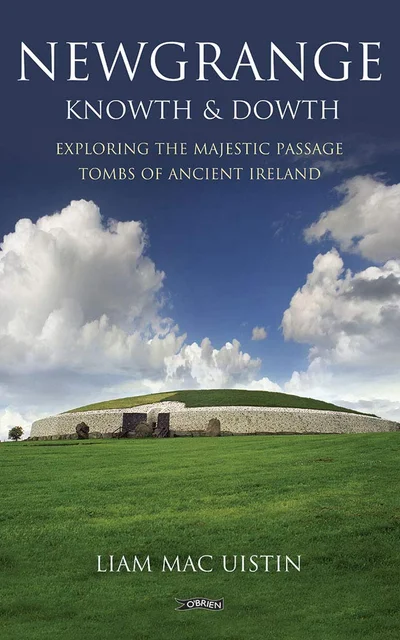
Newgrange, Knowth and Dowth: Exploring the Majestic Passage Tombs of Ancient Ireland by Liam Mac Uistin. Older than the Egyptian pyramids, older than Stonehenge. For 5,000 years the ancient megalithic tomb at Newgrange in County Meath has housed the remains of Stone Age aristocracy, sheltering the spirits of the long dead from the outside world. This book explores the creation, building and discovery of Newgrange.
Why did these people spend years building this tomb? How did they move huge boulders miles across hilly country and erect them at the site, without the aid of machinery? Modern archaeological techniques have revealed much about the lives of our Stone Age ancestors, but Newgrange still retains many of its secrets. Exploring Newgrange uncovers, in words and illustrations, the extent, and limitations, of our knowledge of this world-famous site.
Liam Mac Uistin is a well-known author and playwright. His versions of ancient Irish stories and legends have been published in the Irish language. His plays for stage, television and radio have been produced in many European countries and in Canada, Australia and New Zealand. His stage plays have been produced at the Abbey and Peacock theatres in Dublin. His stories and plays have received many literary awards. Liam Mac Uistin is the author of The Tain (O'Brien Press), a hugely popular book for the young reader on this great Celtic epic. He lives in Dublin with his family.
Purchase at Amazon.com or Amazon.co.uk
Review
Newgrange, Knowth and Dowth: Exploring the Majestic Passage Tombs of Ancient Ireland by Liam Mac Uistin provides a clear and approachable introduction to Newgrange and the wider Brú na Bóinne passage tomb complex, including Knowth and Dowth. Written for a general audience, the book is easy to read and well-structured, making it particularly suitable for those encountering these monuments for the first time.
The book is well illustrated throughout, with maps, reconstruction drawings, and photographs that help explain how the monuments were built, how they may have looked in the past, and how they fit into the landscape of the Boyne Valley. At 111 pages, it is not intended as a detailed academic study, but rather as an accessible overview that presents the key ideas, discoveries, and ongoing questions surrounding these remarkable sites.
While the sleeve notes describe Newgrange as “an amazing Stone Age place of mystery and spiritual worship”, the book itself adopts a more encyclopaedic style. This clear, factual approach will appeal to readers who want a solid grounding in the archaeology and history of Newgrange before exploring more specialist or academic works.
Who Built Newgrange
Many years have passed since I first saw the great mound of Newgrange dominating the Boyne Valley in County Meath. It was then in a somewhat dilapidated state, overgrown in part with nettles and other weeds. Cattle grazed around it, unaware that they were intruding on the site of one of the most remarkable prehistoric monuments in Europe.
After some hazardous scaling of walls and fences I found the custodian of the site, an elderly lady who lived in a nearby cottage. Armed with a few candle stubs, and wearing a leather apron as protection against drips of candle grease, she escorted me to the entrance of the mound and led me inside. By the flickering candlelight, the interior began to be revealed. Huge stone slabs, engraved with strange designs, loomed out of the darkness.
The further I ventured along the passage the more I felt the macabre enchantment of this cold, silent, secretive place wrapping itself around me. It is impossible to ignore the magical power of Newgrange. Once inside the tomb, I was transported back through the ages. Laying my hand on one of the beautiful spiral carvings, I could almost feel the hand of the Stone Age artist who picked out, with infinite care and precision, this mysterious communication on the silent stone. Newgrange has an undeniable sense of spiritual calm that, once experienced, is never forgotten.
When I emerged into daylight again, I was still mesmerised by the enigmatic aura of the tomb. It was some minutes before I could readjust my thoughts from images of the past to the present day. When I revisited Newgrange in more recent times, I was fascinated by the transformation in the appearance of the tomb. The mound had been reconstructed to resemble, as closely as possible, what was considered to be its original state when completed around 3200 BC, some 5000 years ago.
Seen from the valley below, with its spectacular façade of gleaming white quartz stone, Newgrange is now a striking visual reminder of its Gaelic name, Si an Bhrú - the Fairy Mound. It has a magical appearance, like a fairy fort looming up over the valley. Once again I ventured through the entrance and along the passage, but this time with the aid of artificial light which shows the decorative work within the tomb to its full effect. Once again I marvelled at the skill of the prehistoric people who had conceived of and constructed this astounding, lasting monument to their culture. I imagined them as ordinary people, with everyday worries and concerns, but dedicated, with unwavering determination, to the completion of this awe-inspiring project.
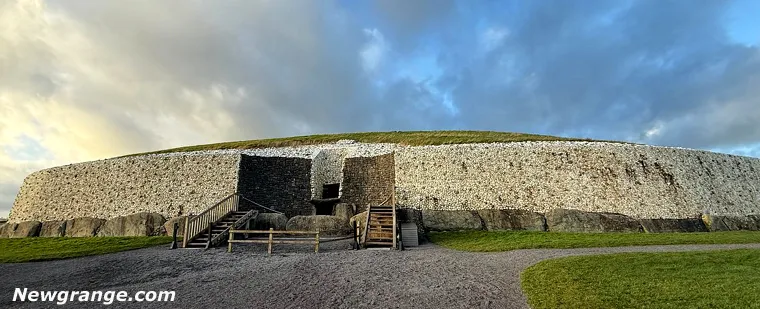 Newgrange as it stands today, after restoration work has replaced the white quartz façade and altered the entrance.
Who were these extraordinary people and what was their way of life? Even now, after Newgrange has been extensively excavated, relatively little is known about them. Archaeologists are still attempting to piece together their story from the sparse clues they left behind when they, and their way of life, vanished from the Boyne Valley.