Newgrange Kerbstone 67
Kerbstone K67 stands on the north-eastern side of the kerb at Newgrange in the Boyne Valley. With the entrance stone (K1) and Kerbstone 52, Kerbstone K67 is one of three fully panelled kerbstones at Newgrange. Megalithic art on the stone is illustrated in Claire O'Kelly's corpus in Michael J. O'Kelly's Newgrange: Archaeology, Art and Legend.
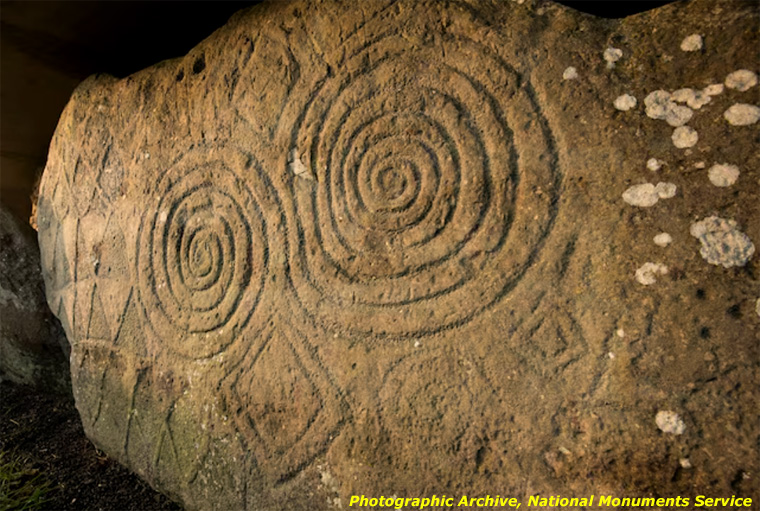 Newgrange Kerbstone K67 - Photo from the Photographic Archive, National Monuments Service.
Kerbstone K67 is one of the most heavily decorated stones on the site. The left half of the stone is covered with a neat pattern of diamond and triangle shapes carved in a repeating grid.
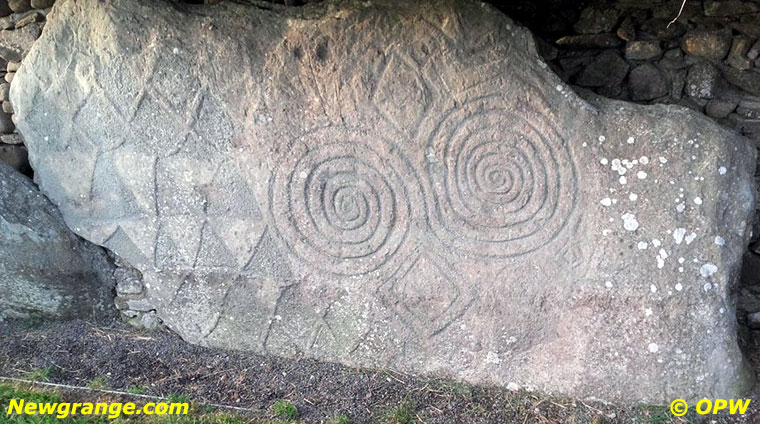 Newgrange Kerbstone K67.
The right half is very different and shows two large spirals placed beside each other. The stone is important because it shows two major styles of Newgrange art side by side. One side uses straight lines and sharp angles while the other uses flowing curves.
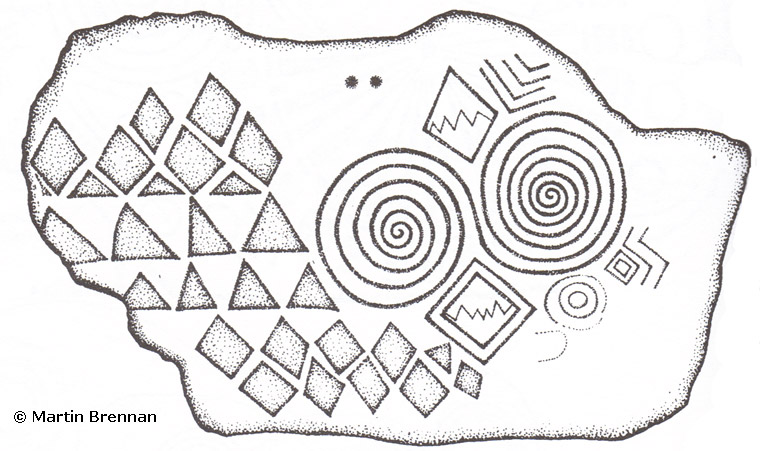 Newgrange K67 drawing by Martin Brennan from The Stones of Time.
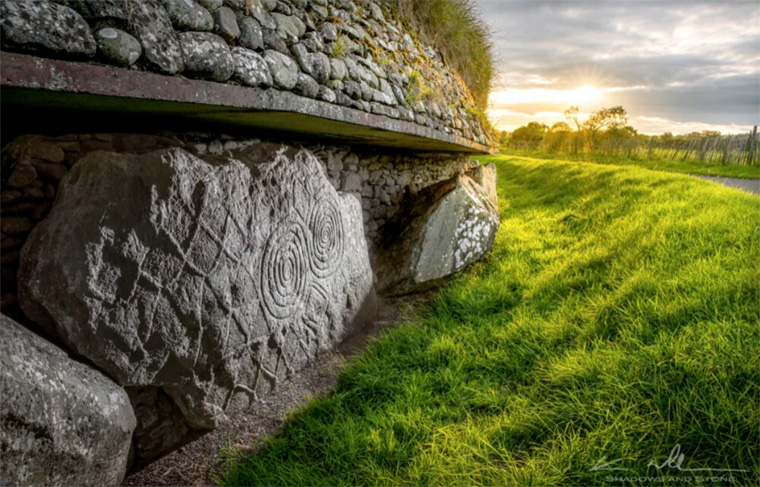 Newgrange K67 - Photo by Ken Williams.
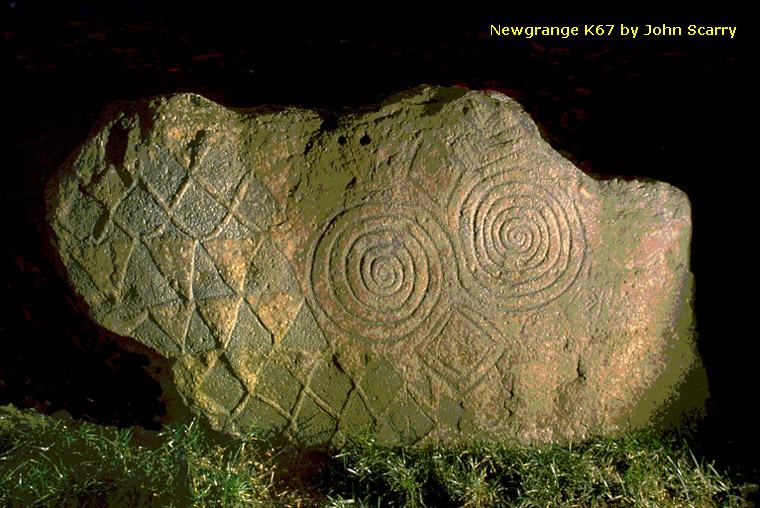 Newgrange Kerbstone 67 - Artistic Posterization by John Scarry.
Posterization is a digital image processing technique which results in the conversion of a continuous gradation of tone to some areas of fewer tones, often causing dramatic changes from one colour tone to another.
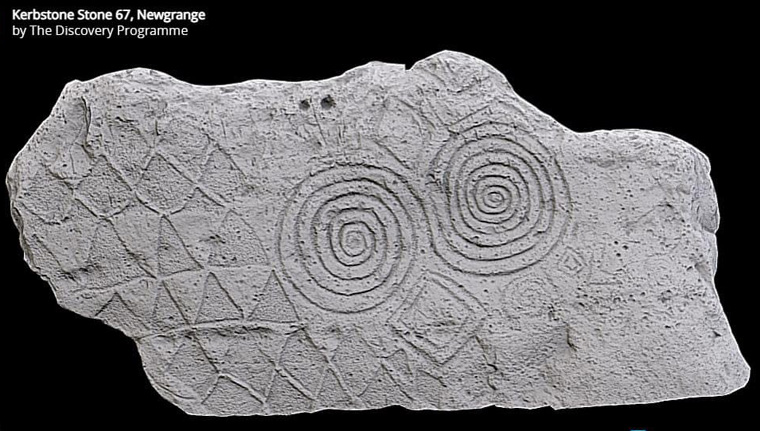 Newgrange kerbstone 67 | Digital 3d model produced by the Discovery Programme.
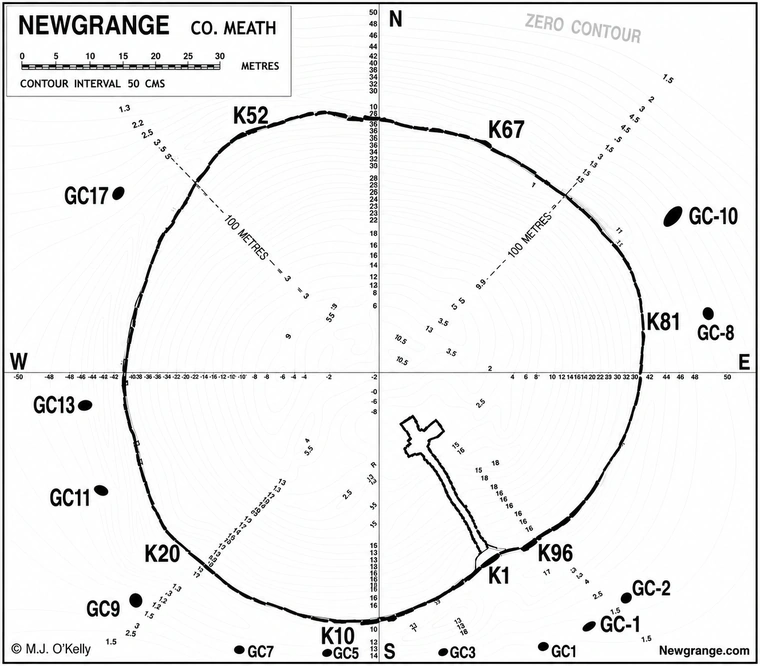 Plan of Newgrange Mound adapted from Newgrange - Archaeology, Art and Legend.
Newgrange | Brú na Bóinne
Newgrange is a prehistoric monument located in the Boyne Valley within Ireland's Ancient East, and is part of the Brú na Bóinne archaeological complex. Constructed around 3200 BCE, it is a large circular mound with a passageway leading to a central chamber. Newgrange is renowned for its winter solstice phenomenon, where sunlight penetrates the passage and illuminates the inner chamber, demonstrating an ancient understanding of astronomy.
Brú na Bóinne encompasses several prehistoric monuments, with Newgrange and Knowth being the most prominent. Brú na Bóinne is recognised as a UNESCO World Heritage Site, reflecting its importance in understanding the Neolithic period and the development of ancient Ireland.
Kerbstones are large stones that form a ring around the base of passage tombs in Ireland, and they are a distinctive feature of sites like Newgrange and Knowth. Many of the kerbstones, particularly at Knowth, are adorned with intricate megalithic art, featuring geometric patterns, spirals, and symbols.