Exhibition at the Solstice Arts Centre, Navan
Lost and Found - Exploring the Megalithic Art of County Meath
Opening Night: Thursday 2nd September 2010, Time: 7.30pm
Exhibition continues until Thursday 23rd September 2010
Lost and Found is an exhibition that explores the megalithic art of County Meath by connecting investigative practices of archaeologist and artist.
The Bend of the Boyne, or Brú na Bóinne is internationally renowned for its elaborate Neolithic passage tombs, containing the largest assemblage of megalithic art in Europe.
Professor George Eogan's prolific factual study of megalithic art of the county interlinks with the diverse work of four contemporary artists. Curated by Brian Fay, Niall de Buitléar, Fiona Hallinan, Anna MacLeod and Sabina Mac Mahon query the modern-day relation of iconic megalithic art and sites in County Meath.
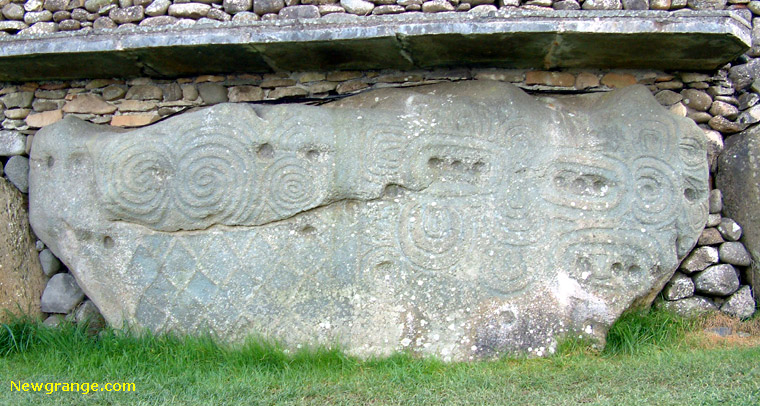 Megalithic Art on Kerbstone 52 at Newgrange.
We Are Where We Were...
Brian Fay, curator.
We are where we are. This phrase, now constantly used to explain our current economic situation, succinctly suggests that we must avoid looking at our past and focus solely on our present. Put simply, this saying encourages us to ignore the useful lessons of what has gone before. Or perhaps it empathises with the black-humoured Russian maxim that "The past is more difficult to predict than the future".
The investigation and examination of ourselves in relation to our past is a necessary and complex one. Within the visual arts there has been a resurgence of interest and activity in looking at the practices and methods of historians and archaeologists. For example, the winner of the 2010 Cartier Award at London's Frieze Art Fair is the site-specific installation, Frozen. This work is an imagined archaeological discovery of a fictional ancient lost city found under the site of the Art Fair. Visitors can expect to find archaeological digs, displays of artefacts and information panels describing the supposed historic civilisation that was also once a centre of art and trade.
The Sixth World Conference of Archaeology, held at University College Dublin in 2008, had two full sessions entitled Site-specific: Between Archaeologists and Artists and Art, Archaeology, Space and Process given to the subject of artistic investigations into the past. Four related contemporary art exhibitions formed part of the conference's programme of events. There have been collaborations between archaeologists and artists such as Art+Archaeology and numerous publications including Andrew Cochrane and Ian Russell's Visualizing Archaeologies: A Manifesto (2007), Colin Renfrew's Figuring It Out (2003) and Substance, Memory, Display: Archaeology and Art (2004), Tim Ingold's Lines: A Brief History (2007) and Paul Eggert's Securing the Past (2009).
Intrinsically linked to any examination of the past is the spectre of nostalgia. Nostalgia is inclined to be the recipient of bad press. As the historian Charles Maier put it, "Nostalgia is to memory as kitsch is to art", or perhaps even more harshly pronounced by writer Michael Kamen that "Nostalgia is essentially history without guilt". However, in her book The Future of Nostalgia (2001), Svetlana Boym attempts to rehabilitate these assumptions by arguing for a model of nostalgia that is not anti-progress, that doesn't deny time or wallow in the sentimental.
Instead, she proposes that "Nostalgia is about the relationships between individual biography and the biography of groups or nations, between personal and collective memory". Boym then divides nostalgia into two main categories, the restorative and the reflective. She argues that restorative nostalgia seeks to find evidence of the past that can be put together to create one seamless chronological central story or tradition towards our understanding, or misunderstanding, of our community, society or country, which excludes any other readings. This is frequently an invented tradition, dogmatic in tone, offering a single coherent vision of the past.
In contrast, reflective nostalgia inhabits many places at once as well as different time zones. It opens out our understanding of the past by presenting many stories and versions for us to question what has gone before. Reflective nostalgia invites us to enquire and compare rather than accept one single story. Boym goes on to say that "You don't deny your longing [of the past], but you reflect on it somehow... It's a positive force that helps us explore our experience, and can offer an alternative to an uncritical acceptance of the present."
This classification of nostalgia is arguably the more open and allows us to create and interpret artefacts and remains of what has gone before. While I am not making the claim that every artist who investigates aspects of the past deals solely with nostalgia, I believe that Boym's definition of reflective nostalgia gives us as viewers a space to respond openly and questioningly to what is presented.
When artists are looking at archaeology and history as a source for works, where does that leave the archaeologist and historian? The Irish curator and academic researcher Ian Russell states that for archaeologists, "To focus only on the scientific aspects of archaeology is, however, to only tell half of the story".
For Russell, "The narrative of archaeology is as much, if not more so, about the fascination of encountering and mediating things today whose stories one is compelled to construct or reconstruct from traces and residues, absences and presences."
Of course, this does not make the case for wilfully inventing claims based on material evidence or artefacts that distort a proven history. For example, if a tractor part is found on an archaeological dig at a megalithic site, it does not mean that megalithic man had New Holland tractors. It does, however, create the space for archaeology not to be solely about the past but as much about a constructed dream or story of the past. As Russell explains:
"The performance of archaeology is an attempt to realise these dreams, these pasts, but to control and structure their appearances through rationally manifested knowledge and information."
The key phrase here is "rationally manifested knowledge", which does not exclude creative readings and presentations but is dependent on forms of verification.
The standard verification model is the scientific method that establishes proof based on reproducibility. Observations and actions produced under the same conditions, usually in a laboratory, will always yield the same results. Therefore, a consensus is reached and fact established. However, not all sciences operate this way.
Many depend on thought experiments, described in papers or perhaps more recently in computer simulations. Darwin's theory of evolution, Einstein's imagined experiments on the function of time, and Wegener's tectonic plates theory were all produced outside of the laboratory. Yet central to each of these now accepted claims is the coupling of imagination to logic. Each starts with a surviving structure, whether archive or artefact. It goes on to deduce the processes that produced them from received knowledge and present structures.
The thought experiment, therefore, allows the non-reproducible to be validated and accepted. Historians also operate within the thought experiment model. As stated by the writer John Lewis Gaddis in his excellent The Landscape of History (2002), "Historians are able to manipulate time and space... They can compress these dimensions, expand them, compare them, measure them, even transcend them, almost as poets, playwrights, novelists and film makers do. Historians have always been, in a sense, abstractionists: the literal representation of reality is not their task."
But he points out that "Artists don't normally expect to have their sources checked. Historians do."
Perhaps this is the central difference between an artist's response to a site and that of an archaeologist or historian. It is the issue of verification, of who validates the claim being made.
We, the viewers of the artworks in this show, have the responsibility to find new readings, reactions, shared stories and validations. We too must start with the objects we see, then deduce the processes that produced them from our present structures and received knowledge. For this to happen, we would have to look at ourselves not just in the present tense but also in the past to define a response for the future.
Brian Fay is an artist and lecturer in Fine Art at D.I.T.
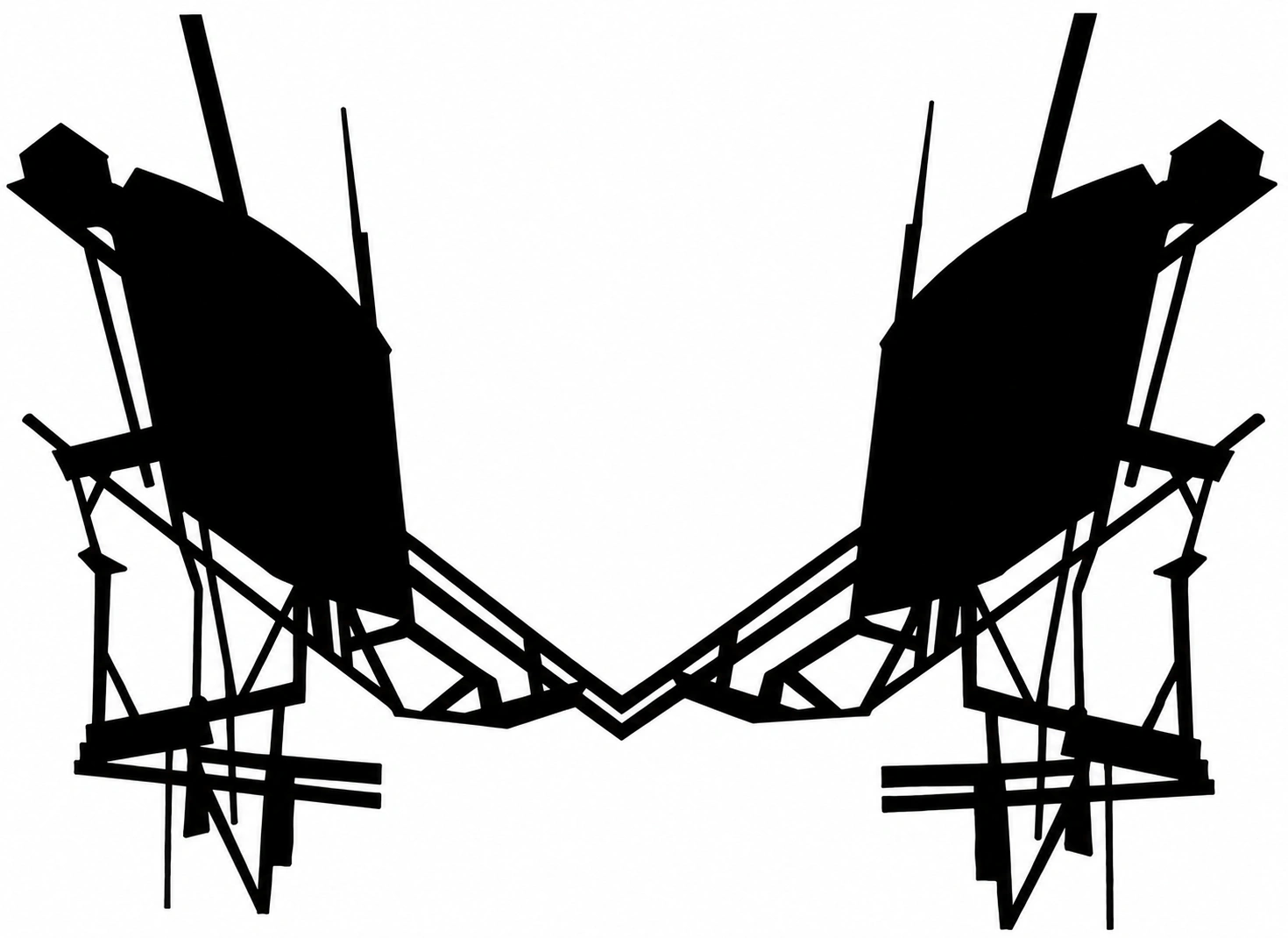 Water Optics by Anna Macleod - 2010.