Knowth Sundial - The Times, September 1980
Letter to the Editor
In an article on the archaeological excavation at Knowth (September 11th) the identification of one of the stones near the entrance as being a sundial was brought into question. If this stone was positively identified as a sundial, it would be the oldest sundial known, pre-dating what are presently regarded as the oldest sundials by some 3,400 years. Presently, the oldest known sundials are from Egypt and are dated at 1500 BC.
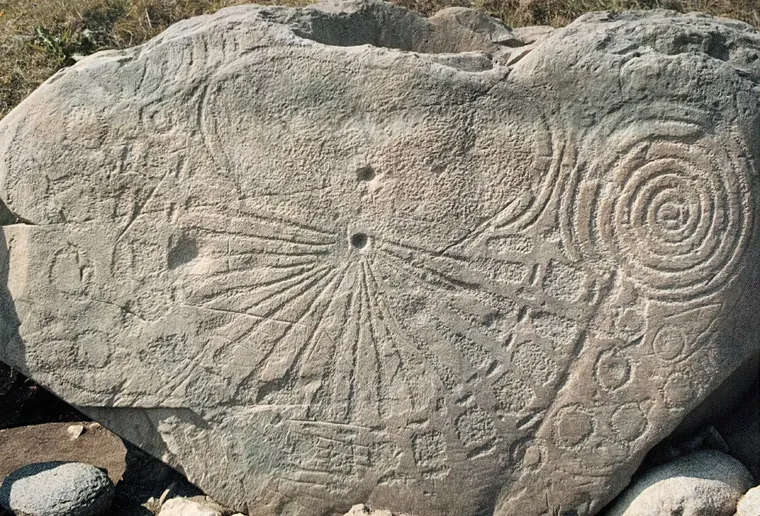 Knowth K15, the Sundial Stone | Photo: National Monuments Service.
In order to avoid useless speculation about the stone, an experiment was set up to determine if the stone was in fact utilised as a sundial in its present situation. Before the experiment began, it was already recognised that the stone had all the requirements of a functional sundial, including gnomon position and radial angles marked clearly. A model of the stone was constructed, gnomons positioned and the bearing of the stone was duplicated.
The model stone was observed and data was collected for over one year. The results of the experiment are, of course, repeatable. There can be no reasonable doubt that not only is the stone in question a sundial but it is a highly sophisticated sundial utilising multiple gnomons and functioning every day of the year. Technically, it would be classified as a vertical east-declining dial. Position of the sun at equinox and summer solstice are particularly heavily inscribed.
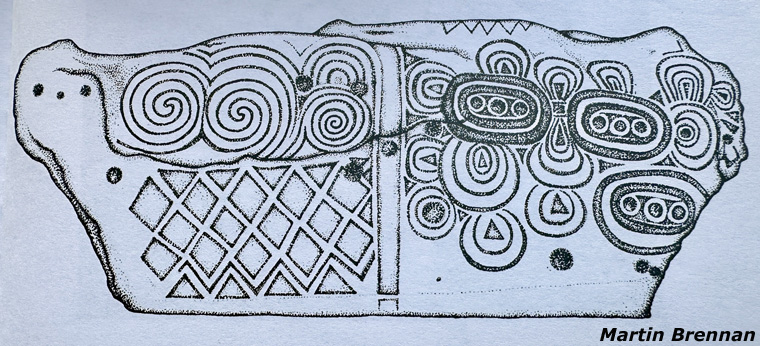 Newgrange Kerbstone 52 drawn by Martin Brennan.
The astronomical data that the sundial is capable of registering far exceeds agricultural requirements and is more in the area of precision timekeeping. Furthermore, the vertical marks that are supposed to mark "tomb" entrances quite clearly mark astronomical alignments. The largest and most obvious vertical mark is on kerbstone 52, Newgrange, marking the position of the rising sun at winter solstice and not marking a "tomb" entrance. At the moment it seems that the only absolutely conclusive evidence we have regarding these mounds is that they are astronomically aligned.
Everything else is pure speculation.
Yours, etc.,
Martin Brennan, 4 Upper Fitzwilliam Street, Dublin 2.