Newgrange is a remarkable Neolithic monument in the Boyne Valley, part of Ireland’s Ancient East and one of the country’s most significant prehistoric sites.
Built around 5,200 years ago, in approximately 3200 BC, it is older than both Stonehenge and the Great Pyramids of Giza.
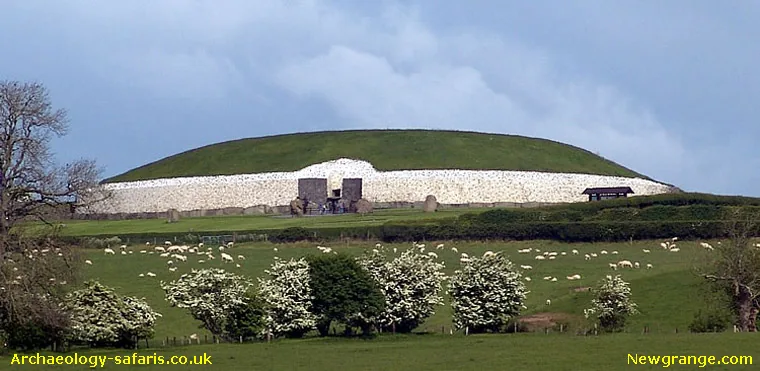
Newgrange, a 5,200 year old Neolithic passage tomb in the Boyne Valley, Ireland’s Ancient East.
Access to Newgrange is via the Brú na Bóinne Visitor Centre,
with visitors brought to the monument as part of a guided tour.
There is no direct public access to Newgrange itself.
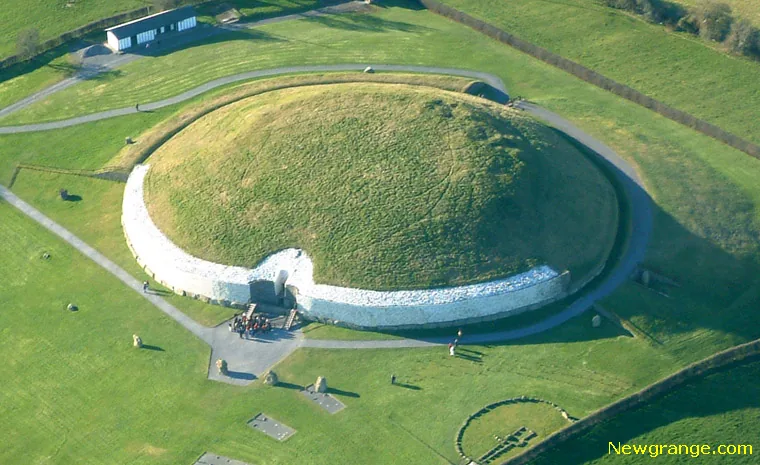
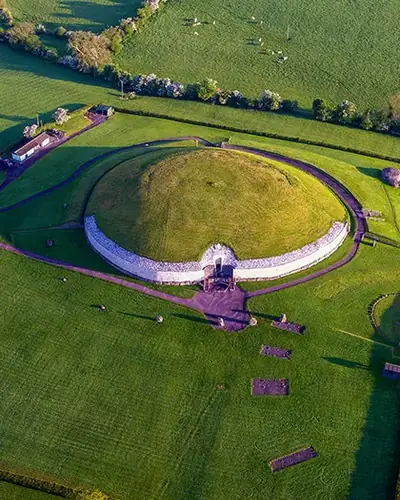
Built by Stone Age farmers, the great circular mound measures approximately
85 metres (279 feet) in diameter and 13 metres (43 feet) high, covering an area of approximately 0.45 hectares (1.1 acres).
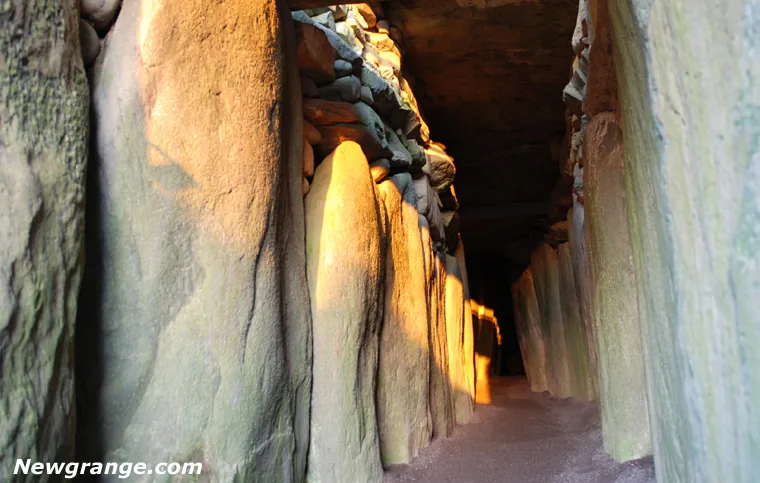
A stone-built passage, 19 metres (62 feet) in length, leads to an inner chamber with three recesses.
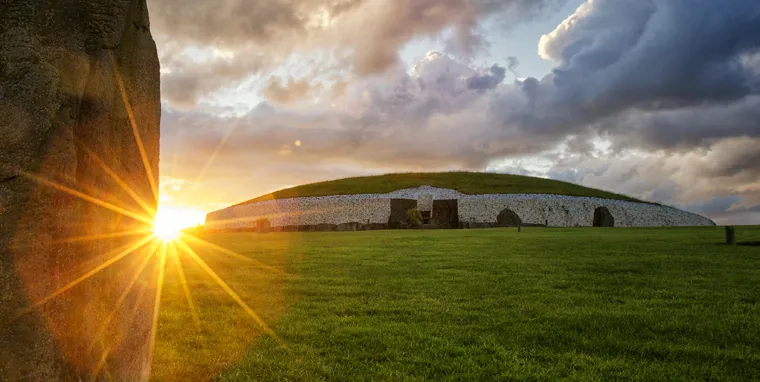
The passage and chamber are precisely aligned with the rising sun on mornings
around the Winter Solstice,
a feature that has made Newgrange famous worldwide.
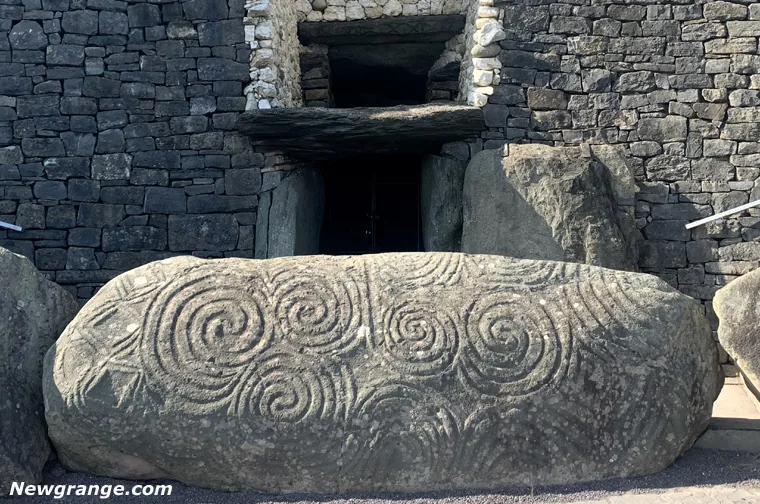
The mound is encircled by 97 large kerbstones, some of which are decorated with
prehistoric carvings known as megalithic art, the most striking being the
entrance stone,
known as Kerbstone 1.
Newgrange Kerbstone K1 - The Entrance Stone.
Newgrange was built by a prosperous Neolithic farming community that lived on the fertile lands of the Boyne Valley.
Alongside Knowth and Dowth, it forms a group of closely related monuments
that together have been designated a World Heritage Site.
While archaeologists originally classified Newgrange as a passage tomb, it is now widely understood to be far more than a place of burial.
It functioned as an ancient temple, with deep astronomical, spiritual, religious, and ceremonial significance.
In this sense, Newgrange can be compared to later cathedrals, places that combined ritual importance, social prestige, and the commemoration of important individuals.
The monument itself is a large kidney-shaped mound covering approximately 0.45 hectares (1.1 acres). It is retained at its base by 97 kerbstones,
some of which are richly carved with Neolithic megalithic art. A 19 metre (62 feet) long passage leads into a cruciform chamber
capped by a finely constructed corbelled roof. The scale, precision, and labour involved in building Newgrange point to a highly organised society,
with specialised groups responsible for design, construction, and decoration.
Newgrange is part of a wider ceremonial landscape built along a bend of the Boyne, known collectively as Brú na Bóinne.
In addition to Newgrange, the complex includes Knowth, the largest of the monuments, and Dowth, as well as up to 35 smaller mounds spread across the surrounding area.
Visitor Information
Visitor access to Newgrange and Knowth is strictly by guided tour through the Brú na Bóinne Visitor Centre,
located on the south side of the River Boyne. Newgrange and Knowth lie on the north side of the river. Visitors cross the River Boyne
via a pedestrian bridge and then travel to the monuments by shuttle bus. There is no direct public road access to Newgrange or Knowth.
When using a GPS satellite navigation system, the Brú na Bóinne Visitor Centre should be entered as the destination.
Newgrange is best known for the illumination of its passage and chamber by the winter solstice sun.
Above the entrance to the passage at Newgrange there is an opening called a roof-box. This baffling
orifice held a great surprise for those who unearthed it.
Its purpose is to allow sunlight to penetrate
the chamber on the shortest days of the year, around December 21st, the winter solstice. At dawn,
from December 19th to 23rd, a narrow beam of light penetrates the roof-box and reaches the floor of the chamber,
gradually extending to the rear of the chamber.
Winter Solstice sunbeam illuminating Newgrange.
As the sun rises higher, the beam widens within the chamber so
that the whole room becomes dramatically illuminated. This event lasts for 17
minutes, beginning around 9am. The accuracy of Newgrange as a time-telling device is remarkable when one considers
that it was built 500 years before the Great Pyramids and more than 1,000 years
before Stonehenge.
The intent of the Stone Age farmers who built Newgrange was undoubtedly to mark the beginning of the new year. In
addition, it may have served as a powerful symbol of the victory of life over
death.
Each year the winter solstice event attracts much attention at Newgrange. Many
gather at the ancient tomb to wait for dawn, as people did 5,000 years ago. So
great is the demand to be one of the few inside the chamber during the solstice
that there is a free annual lottery. Each person drawn can bring a guest.
Unfortunately, as with many Irish events that depend upon sunshine, if the skies are overcast, there is
not much to be seen. Yet all agree that it is an extraordinary feeling to wait
in the darkness, as people did so long ago, for the longest night of the year to end.
On the mornings around the winter solstice, members of the public are welcome to gather outside the entrance to the Newgrange monument to witness the sunrise.
Access is free on these mornings, and visitors begin their journey at the Brú na Bóinne Visitor Centre, from where shuttle buses operate to Newgrange.
While chamber access at sunrise is restricted to solstice lottery winners, those attending can experience the atmosphere at the monument itself and
after sunrise, may have an opportunity to queue for limited post-event entry to the chamber.
Newgrange Resources
Education Packs
follow the school curricula and are an aid for teachers and students.
A private tour through the UNESCO World Heritage landscape of Brú na Bóinne.
Join the official guided tours of Newgrange and Knowth, while we handle transport around the scheduled tomb visits.
Continue to the Hill of Slane, traditionally associated with Saint Patrick,
and the Hill of Tara, the ancient ceremonial seat of Ireland's High Kings.
Enjoy convenient pickup from your accommodation and a relaxed, carefully planned journey through one of Ireland's most historic landscapes.