Lughnasadh - Cross Quarter Day
Lughnasadh (Lughnasad, Lughnasa, Lugnasad, Lúnasa) - pronounced Lou-na-sa.
In Celtic mythology the god Lugh one of the chief gods of the Tuatha Dé Danann, established the Lughnasadh festival as a funeral feast and games commemorating his foster-mother Tailtiu. She died on August 1st of exhaustion after clearing the plains of Brega for farming. The ancient kingdom of Brega was bounded on the south by the River Liffey and extended northwards across the Boyne Valley. The first Teltown Games (Áenach Tailteann) were held where Tailtiu was buried on the banks of the River Blackwater before it joins the River Boyne.
The Neolithic, or Stone Age, communities of the Boyne Valley placed great importance on the movement of the sun through the year. Their monuments were carefully aligned with key solar events such as the Winter Solstice, the Equinoxes, and the Summer Solstice. These alignments demonstrate a sophisticated understanding of the solar cycle and reflect the central role of light, time and seasonal change in their belief system and daily lives.
Beyond these major solar markers, the year was further structured by the halfway points between them, known as the cross quarter days. These included Imbolc, Beltane, Lughnasadh and Samhain, which signalled important transitions in the agricultural and ritual calendar. During the later Celtic period, it was these cross quarter festivals that assumed greater cultural significance, shaping seasonal observances, mythology and social life long after the construction of the great Neolithic monuments.
The stage play Dancing at Lughnasa by Brian Friel is set in 1936 in the fictional town of Ballybeg (based on the Glenties in Co. Donegal). The play takes place around Lughnasa, the festival of the first fruits, when the harvest is welcomed. Dancing at Lughnasa was adapted for film in 1998 starring Meryl Streep.
Lughnasad - Oil Painting by Ric Kemp
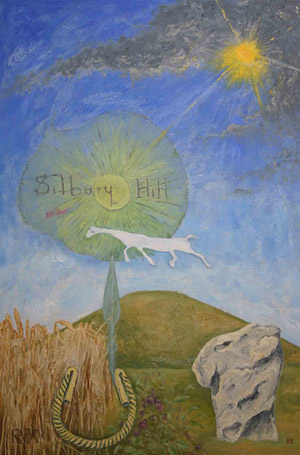 Painting of Lughnasadh with wheat sheaf.
Lughnasad is the Celtic name for Lammas, time of the 'first fruits' of harvest. Lugh (Lleu) is an ancient god associated with the time of harvest, horse and livestock fairs, often held on hilltops. The painting suggests the sudden summer storms which sometimes occur at this time of year, with the sun mirrored in the round shape of Silbury Hill - part of the Avebury Complex. The gold torc and Bronze Age spearhead were both recovered from the local downs in 1844 by a man digging for flints.
Featured are mature corn and sloe berries which ripen through August. A livestock fair was held on Tan Hill at this time of the year for centuries - close to where the torc was found - and may even date back to the Neolithic period. The chalk hill figure is the nearby white horse from Alton Barnes which seems to be echoed in the 'horse head' shape of West Kennet Avenue Stone 37B (lower right). The horse heads, of which there are several at Avebury may also be deer or doe; a quantity of carefully deposited deer antler was recovered from Silbury Hill during excavation.
Oil on Canvas - 610x915mm (24"x36") from a cycle of eight paintings by Ric Kemp illustrating the possible eight stations of the megalithic year at Avebury Stone Circle in Wiltshire, England.
The Festival of Lughnasa by Máire MacNeill
A study of the survival of the Celtic festival of the beginning of harvest.
 Garland
Sunday and Domhnach Chrom Dubh are two of the many names of a festival
celebrated by Irish country people at the end of July or the beginning of
August. It marked the end of summer and the beginning of the harvest season, and
on that day the first meal of the year's new food crop was eaten. The chief
custom was the resorting of the rural communities to certain heights or
water-sides to spend the day in festivity, sports and bilberry-picking. The
custom existed also in the Isle of Man, Cornwall, Wales and in the north of
England. Formerly it must have been general in all Celtic lands for there is no
doubt that it is a survival of Lughnasa (Lugnasad), the Celtic festival held on the first of August.
Garland
Sunday and Domhnach Chrom Dubh are two of the many names of a festival
celebrated by Irish country people at the end of July or the beginning of
August. It marked the end of summer and the beginning of the harvest season, and
on that day the first meal of the year's new food crop was eaten. The chief
custom was the resorting of the rural communities to certain heights or
water-sides to spend the day in festivity, sports and bilberry-picking. The
custom existed also in the Isle of Man, Cornwall, Wales and in the north of
England. Formerly it must have been general in all Celtic lands for there is no
doubt that it is a survival of Lughnasa (Lugnasad), the Celtic festival held on the first of August.
In the description of the celebration much emerges of the old life of the countryside. The people preserved legends of the origin of the festival and of the assembly-sites, it has been possible to show a correspondence with ancient mythology, as expressed in Irish literature and in the cult-figures of Roman Gaul. The dominant myth of the festival is brought to light.
A panorama, both extensive and detailed, is unfolded in the study, which reveals, inter alia, the nature of Crom Dubh, shows that legends of Cú Chulainn, Saint Patrick, and Cornwall's Jack the Tinkard originate in tales of Lugh, suggests why Jephthah's daughter was connected with the festival in the Isle of Man, glances at the medieval cult of Saint James, and interprets anew the battle of Moytura and the Étain saga. It shows a relationship between the old assembly of Tailtiu and the Croagh Patrick pilgrimage. It discusses Puck Fair. It ranges from Lugudunum in first-century Gaul to Dún Lughaidh at the foot of Errigal. Figures from Irish mythology, hagiography and history throng its pages.
The author Máire MacNeill (1904-1987) studied at University College Dublin, and was a graduate of the National University of Ireland. From 1935 to 1949 she was a member of staff of the Irish Folklore Commission. She was a co-editor and translator of Sí-Scéalta ó Thír Chonaill / Fair legends from Donegal in the Comhairle Bhéadoideas Éireann series Scríbinní Béaloidis / Folklore Studies and the translator of Séamus Ó Duilearga's Leabhar Sheáin í Chonaill - Seán O Conaill's Book in the same series.
Purchase at Amazon.com or Amazon.co.uk