Newgrange Kerbstone K6
It is one of the 97 kerbstones numbered in Professor Michael J. O'Kelly's record of the monument. Walking clockwise from the entrance stone (K1), K6 is five stones away from the entrance.
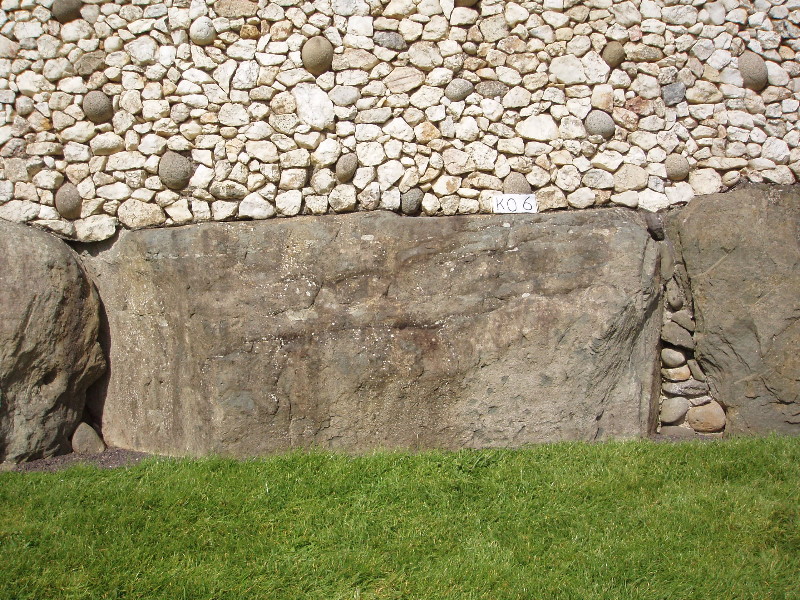 Newgrange Kerbstone K6
Megalithic art on the back face of Kerbstone K6 is illustrated in Claire O'Kelly's corpus (Michael J. O'Kelly, Newgrange: Archaeology, Art and Legend, Part 5).
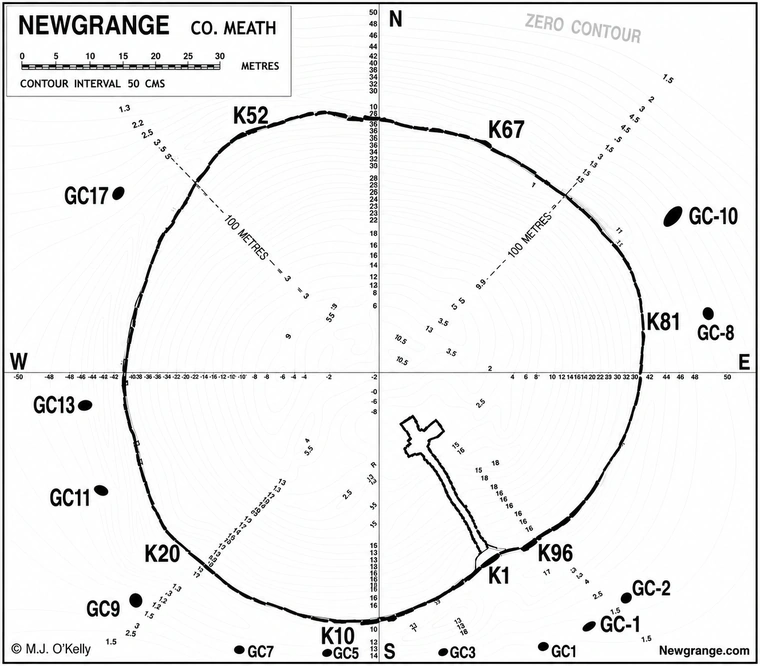 Plan of Newgrange Mound adapted from Newgrange - Archaeology, Art and Legend
Newgrange – Archaeology, Art and Legend
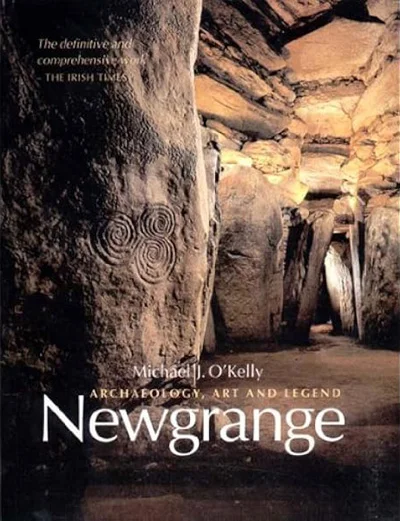 Newgrange – Archaeology, Art and Legend
by Professor Michael J. O'Kelly and Claire O'Kelly is the definitive archaeological study of Newgrange and one of the most important books ever published on an Irish prehistoric monument.
Newgrange – Archaeology, Art and Legend
by Professor Michael J. O'Kelly and Claire O'Kelly is the definitive archaeological study of Newgrange and one of the most important books ever published on an Irish prehistoric monument.
Based on Professor Michael J. O'Kelly's excavations between 1962 and 1975, the book explains the construction, chronology, megalithic art and winter solstice alignment of Newgrange. O'Kelly also describes the excavation, interpretation and restoration of the great passage tomb using detailed archaeological records and architectural analysis.
Richly illustrated throughout, the volume includes the important contribution of Claire O'Kelly, who collaborated closely in the excavation and recording of the site from its earliest seasons.
First published in 1982, with a paperback edition in 1988, the book remains an essential reference for anyone interested in the archaeology, megalithic art and wider significance of Newgrange and the Boyne Valley.
Purchase at Amazon.com or Amazon.co.uk
Newgrange | Brú na Bóinne
Newgrange is older than the great pyramids and as old as the primary phases of Stonehenge. Its builders belonged to farming communities who also raised cattle, cultivated cereals and buried their dead in elaborately constructed tombs.
The 19-metre passage rises gently toward the chamber, built on imported cobbles and lined with orthostats. Kerbstone K1, directly outside the mouth, greets visitors with spirals and lozenges carved in relief.
Dowth and Knowth lie within walking distance along the Boyne; each has its own kerb numbering system and art styles. Comparisons between the three mounds help archaeologists trace development of the Boyne necropolis.
Kerbstones 22 to 46 remain largely buried under the cairn on the north-western side; the index on kerbstones.htm shows which stones are fully exposed today.