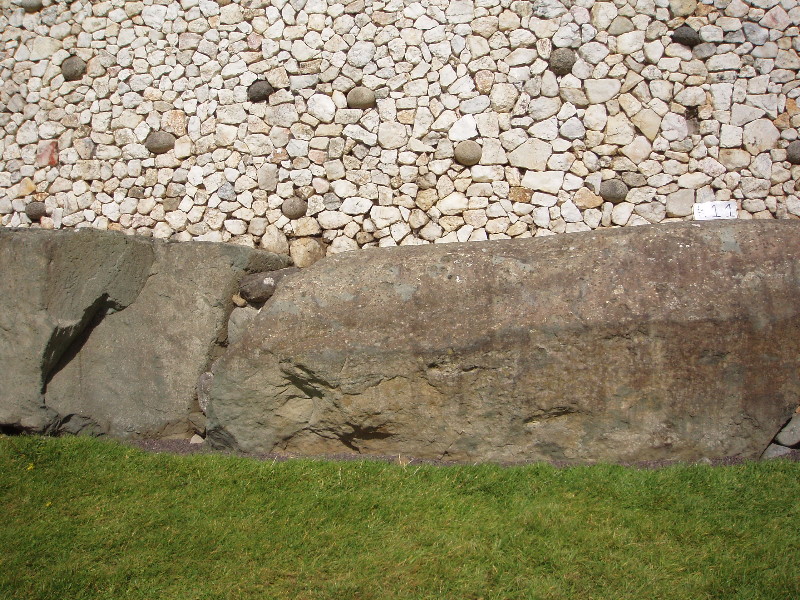
Newgrange Kerbstone K11
It is one of the 97 kerbstones numbered in Professor Michael J. O'Kelly's record of the monument. Walking clockwise from the entrance stone (K1), K11 is ten stones away from the entrance.
 Newgrange Kerbstone K11
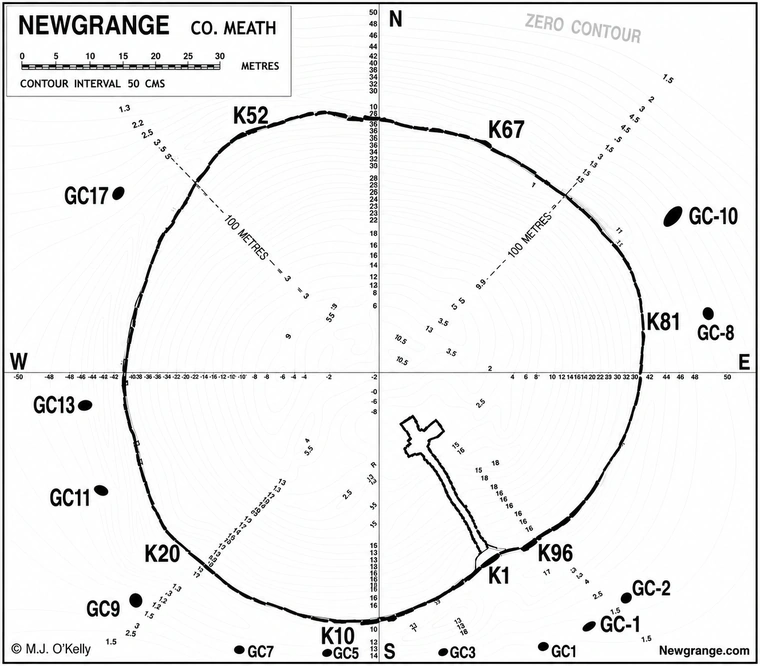 Plan of Newgrange Mound adapted from Newgrange - Archaeology, Art and Legend
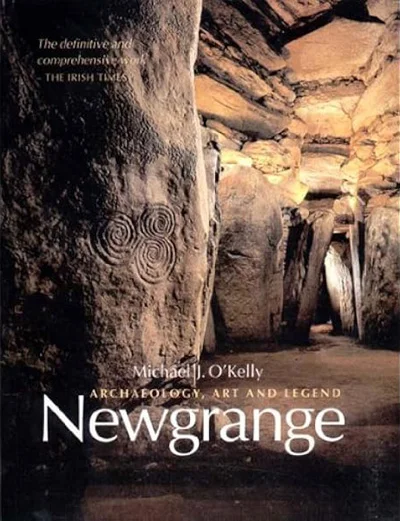
Newgrange – Archaeology, Art and Legend
 Newgrange – Archaeology, Art and Legend
by Professor Michael J. O'Kelly and Claire O'Kelly is the definitive archaeological study of Newgrange and one of the most important books ever published on an Irish prehistoric monument.
Newgrange – Archaeology, Art and Legend
by Professor Michael J. O'Kelly and Claire O'Kelly is the definitive archaeological study of Newgrange and one of the most important books ever published on an Irish prehistoric monument.
Based on Professor Michael J. O'Kelly's excavations between 1962 and 1975, the book explains the construction, chronology, megalithic art and winter solstice alignment of Newgrange. O'Kelly also describes the excavation, interpretation and restoration of the great passage tomb using detailed archaeological records and architectural analysis.
Richly illustrated throughout, the volume includes the important contribution of Claire O'Kelly, who collaborated closely in the excavation and recording of the site from its earliest seasons.
First published in 1982, with a paperback edition in 1988, the book remains an essential reference for anyone interested in the archaeology, megalithic art and wider significance of Newgrange and the Boyne Valley.
Purchase at Amazon.com or Amazon.co.uk
Newgrange | Brú na Bóinne
Newgrange entered European consciousness early: Edward Lhwyd described the entrance stone in 1699 after the mound was opened. Full scientific excavation waited until the twentieth century.
O'Kelly's restoration decisions, especially the quartz façade, remain controversial among archaeologists, yet his publication and Claire O'Kelly's art corpus provide an indispensable record of what was found.
The World Heritage Site boundary includes buffer zones protecting viewsheds and related monuments. Planning controls restrict development that would harm the setting of the passage tombs.
Among the largest kerbstones are K91, K92 and K93 on the south-eastern side, each several metres long. Combined, the kerb ring has been estimated to weigh more than 600 tonnes.