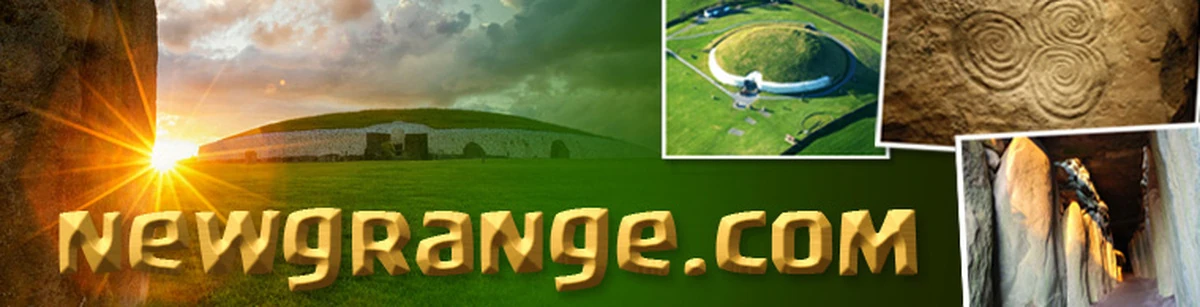
Newgrange Kerbstone K13
It is one of the 97 kerbstones numbered in Professor Michael J. O'Kelly's record of the monument. Walking clockwise from the entrance stone (K1), K13 is twelve stones away from the entrance.
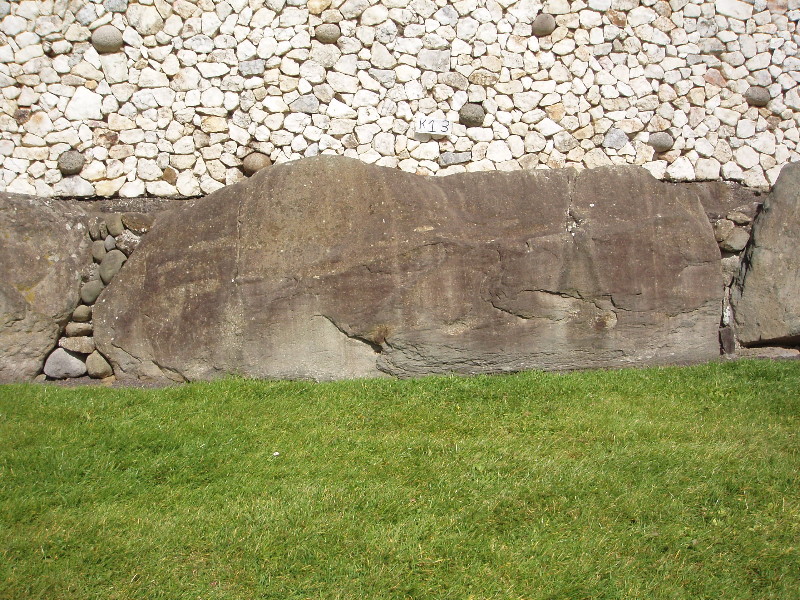 Newgrange Kerbstone K13
Megalithic art on Kerbstone K13 is recorded on the inner or back face only, not on the visible outer face in the photograph above. Claire O'Kelly illustrated it as kerbstone 13 (back) in Michael J. O'Kelly's Newgrange: Archaeology, Art and Legend (Part 5).
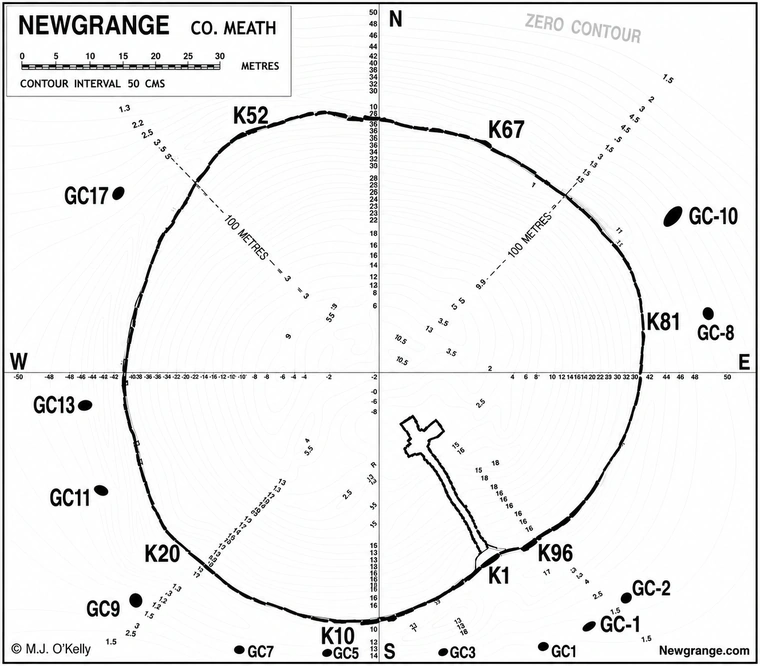 Plan of Newgrange Mound adapted from Newgrange - Archaeology, Art and Legend
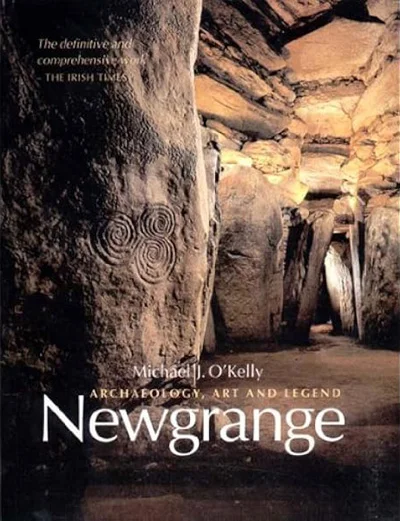
Newgrange – Archaeology, Art and Legend
 Newgrange – Archaeology, Art and Legend
by Professor Michael J. O'Kelly and Claire O'Kelly is the definitive archaeological study of Newgrange and one of the most important books ever published on an Irish prehistoric monument.
Newgrange – Archaeology, Art and Legend
by Professor Michael J. O'Kelly and Claire O'Kelly is the definitive archaeological study of Newgrange and one of the most important books ever published on an Irish prehistoric monument.
Based on Professor Michael J. O'Kelly's excavations between 1962 and 1975, the book explains the construction, chronology, megalithic art and winter solstice alignment of Newgrange. O'Kelly also describes the excavation, interpretation and restoration of the great passage tomb using detailed archaeological records and architectural analysis.
Richly illustrated throughout, the volume includes the important contribution of Claire O'Kelly, who collaborated closely in the excavation and recording of the site from its earliest seasons.
First published in 1982, with a paperback edition in 1988, the book remains an essential reference for anyone interested in the archaeology, megalithic art and wider significance of Newgrange and the Boyne Valley.
Purchase at Amazon.com or Amazon.co.uk
Newgrange | Brú na Bóinne
For students of megalithic art, Newgrange offers a controlled corpus: every decorated stone drawn to scale, with hidden faces documented before backfilling or concrete retention walls sealed them from view.
Kerbstones 6, 13 and 18 carry the best-known hidden panels, now inaccessible behind the entrance retaining structure. Drawings in O'Kelly's book remain the only public record of those inner faces.
The entrance kerb and opposing K52 align on a winter solstice axis through the passage and chamber. K67, due north of the tri-spiral, completes a layout that ties architecture, art and astronomy together.
Whether motifs represent maps, myths, seasons or rank remains unresolved. The art's enduring appeal lies in its age, craftsmanship and placement on stones that still stand where Neolithic hands set them.