Pagan Ireland: Ritual and Belief in Another World
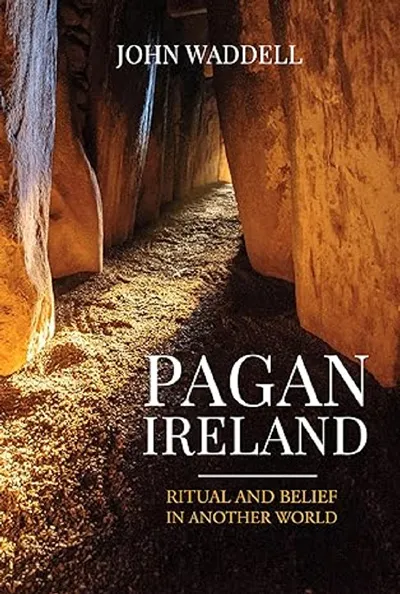
Pagan Ireland by John Waddell examines archaeological evidence for ritual activity across Ireland, exploring how prehistoric communities expressed belief through monuments, deposits, and ceremonial sites. Spanning several thousand years from around 4000 BC, it offers insight into the material traces of ancient traditions.
Written for a general audience, the book combines archaeological interpretation with comparisons from other cultures. Rather than offering fixed conclusions, it considers how patterns in the evidence may reflect underlying systems of belief, with sites such as stone circles understood as purposeful and symbolic constructions.
It also highlights the importance of natural cycles, with evidence suggesting close attention to the movement of the sun and sky, reflected in both monuments and artefacts.
From burial practices to symbolic craftworking, the study presents a broad picture of evolving traditions, revealing a complex and often enigmatic prehistoric belief system.
Purchase at Amazon.com or Amazon.co.uk
Pagan Ireland | Back Cover
Driven by a very human desire to make sense of the world and control their lives, people created sacred spaces and monuments to facilitate communication with the gods and with ancestral figures. A multiplicity of sacred phenomena were part of everyday experience, with landscapes and objects often holding otherworldly meaning.
Written for a general readership, this wide-ranging study draws on archaeological and cultural evidence to address the difficult question of what beliefs might lie behind certain ritual practices. Sometimes it is possible to make a plausible guess as to what these may have been. A circle of stones was more than just a way of marking a sacred space: the round plan was an expression of a belief in a circular, cyclical cosmos, as witnessed in the path of the sun and the fixed stars, and in the rhythm of the year.
Sun worship is recorded throughout prehistory and is apparent not just at famous sites like Newgrange, but also in imagery etched in gold and bronze throughout time. The great disc of the sun travelled across the daytime sky and, at night, was believed to descend beneath the earth in the west, traversing a mysterious underworld, to rise again in the east.
Funerary ceremonies, solar symbolism, magical metalworking, an enduring belief in the cosmic circle, fertility rites, idol worship, and much more were all part of a great pagan tapestry. Veneration of the old gods survived well into Christian times.
Archaeologists frequently come across puzzling evidence for ritual activity, and Pagan Ireland explores a wealth of these discoveries. This work is a survey of the many rituals and beliefs that were vitally important elements of life in ancient Ireland over several thousand years, from 4000 BC onwards.
The Author
John Waddell, formerly Professor of Archaeology at the University of Galway, has written extensively on Irish archaeology. His work on Rathcroghan, a place rich in myth and legend, inspired his interest in Celtic mythology and his book Archaeology and Celtic Myth (2014). Other books by the author include Foundation Myths: the beginnings of Irish archaeology (2005) and The Prehistoric Archaeology of Ireland a new edition (2022), The Celtic World: A History (2026).
Introduction: A Pagan Tapestry
In the nineteenth century various writers described a small stone circle at Lissivigeen, Co. Kerry, as a druidical monument, noting that it was known locally as the “Seven Sisters”. Celtic druids were popular at the time as an explanatory label for many prehistoric monuments, but this circle is a much older ritual site. In fact, it was probably in use in the Bronze Age before 1000 BC. We do not know what pagan rites were performed here but it was probably frequented by priests or ritualists of some description. It was certainly a place with sacred connotations, as its circular plan implies. As we shall see, such ceremonial circles defined sacred space and their architecture was an expression of a belief in a circular, cyclical cosmos, as witnessed in the path of the sun and the fixed stars and in the rhythm of the year.
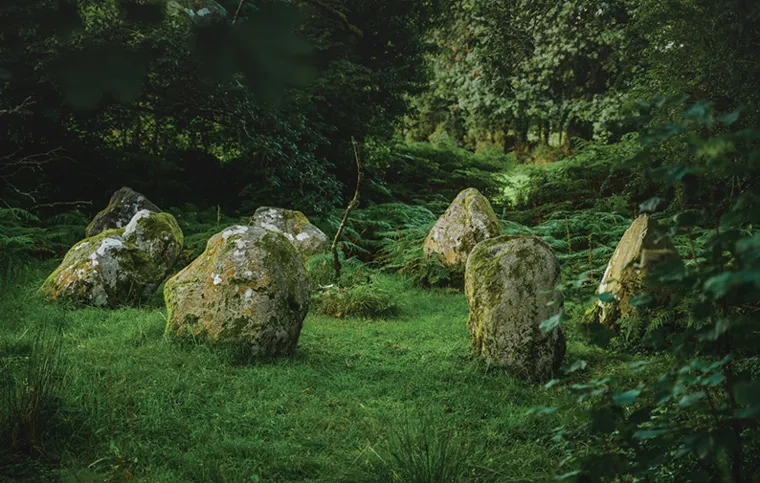 A ritual stone circle at Lissivigeen, near Killarney, Co. Kerry.
“Behind all Irish history hangs a great tapestry, even Christianity had to accept it and be itself pictured there. Nobody looking at its dim folds can say where Christianity begins and Druidism ends …”. So wrote W.B. Yeats in 1937, when he praised the work of scholars like John O’Donovan who, a century before, had recorded so many of the names and legends of the country in their labours for the Ordnance Survey.
This tapestry contains images that are much older than Yeats imagined, for archaeological traces of pagan themes and activities, as at Lissivigeen, can be traced back in time for thousands of years and continued long after the introduction of the new religion. Indeed, the earlier centuries of Christianity’s existence in Ireland were more complex and contradictory than commonly believed.
Archaeology, history, folklore and mythology all have something to tell us about past religious traditions. These reflect a belief in the supernatural in a world that was very different from the present. Archaeology in particular has the capacity to reveal something about beliefs and rituals in Irish prehistory over many thousands of years.
As is well known, the name “pagan” and the concept of paganism were created by early Christians to describe the idol-worshippers and heathens of other religions. It became a derogatory and problematic expression and today some writers would prefer to use terms such as primal, traditional or indigenous religion to designate pre- or non-Christian belief systems. In an Irish context, however, pagan (or paganism) is as good a term as any to describe a remarkably diverse range of ancient indigenous beliefs and practices that, in some instances, helped to shape or even co-existed with more recent Christian phenomena. The concepts of a dying god and a virgin birth were just two pagan themes adopted by early Christianity. As the theologian James P. Mackey once wrote of paganism: “properly appreciated … primal religions provide the basic structures that receive the shape and sustain the existence of all those so-called world religions that strut the stage of human history for as long as each may last”. These great religions, of which Christianity is but one, all started as obscure cultural experiments.
In the past, myths and symbols were keepers of memory, and sacred spaces and monuments were created to facilitate communication with the supernatural and with ancestral figures. The concept of religion as a discrete area of human activity is a relatively modern one. In ancient societies there was no difference between the religious and secular worlds because the sacred or supernatural penetrated all areas of activity. It was embedded in the political, social and economic life of the community and in commonplace, everyday experience. In contrast, today religion, in the sense of a system of institutionalised beliefs, practices and texts, is very much separated from daily life.
A belief in the supernatural is as old as humanity and probably had its origins in a predisposition to detect agency in nature. Religious beliefs are an intrinsic part of human life and may be defined as attempts to give meaning to the world, employing a range of supernatural concepts. This otherworldly realm may include divine figures and spirits in great variety, and myths and ceremonial activities often reflect an engagement with this domain. The objective may be personal or communal benefit, but an important aspect may be the fact that the participants believe that they acquire a measure of meaningful control of the world in which they live.
The religious practices of pagan Ireland embodied a myriad of variable forms spanning many thousands of years. There is an impressively rich body of archaeological evidence to show how they mutated and changed over time. We can confidently see their early traces in the megalithic monuments of the Neolithic era from around 4000 BC. We now know that these stone structures were more than just resting-places for the remains of the dead. Monumentality had deeper meanings. The complex architecture of court tombs, for instance, with their multiple cells and elaborate forecourts, those “gaunt grey ghostly gossips” as James Joyce called them, speak to us about more than just building skills and social complexity.
Functional interpretations embracing factors like communal expertise and organisation may well be true, but these were also religious monuments. They were the focus of complex rituals; they embodied ancestral memories and myths and were places for communion with the gods. The orientation of some monuments and Newgrange is only the best known, tells us that solar phenomena were an important part of the religious cosmology of their builders. While great stone tombs of this sort are very visible expressions of ancient beliefs, many rituals have left little or no trace.
Some years ago the archaeologist Timothy Insoll recorded a ritual sacrifice that he observed in 2002 at a place called Dafra in Burkina Faso, west Africa. Led by a man whom he describes as a priest, the participants entered a forested gorge in which stood a large natural boulder. The stone was smeared with blood and butter extracted from nuts of a local tree. Chickens were sacrificed here and those present were asked to name the animals that they themselves would sacrifice to the gods if their wishes were granted. The celebrant then fed some of the chicken entrails to sacred catfish in an adjacent pool. He rubbed some of the butter from the stone on the hands of each participant, reminding them not to wash them with hot water for the next 24 hours. This concluded the ceremonies. Insoll pointed out that these complicated rites at a sacred place were undertaken by people who firmly believed that they would produce results. Important though these activities at Dafra may have been, an archaeologist would be all too aware that these sorts of rituals would also leave no enduring archaeological expression.
The study of the customs and beliefs of culturally distinct indigenous peoples elsewhere in the world, as at Dafra, is a useful tool, but only in so far as it may broaden our imagination and help to test our modern western ways of thinking. Some prehistoric standing stones or natural boulders decorated with rock art in Ireland may well have been a focus for ceremonial visits and treated like the Dafra boulder. The use of ethnographic analogy can remind us of overlooked aspects of human behaviour but, of course, a custom in a far-off community, no matter how intriguing, is no proof that a similar practice occurred in an Irish context.
Though there has been much debate on what constitutes the evidence for ritual action in archaeology, there is general agreement that the discipline does have the capability to identify ritual customs that tell us something of the ideologies and practices of times gone by. In short, there is merit in the widespread recognition that ritual action is representational, that it is mainly an expression of human attitudes and beliefs.
For some writers performance is a key feature of ritual, be it religious or secular. This might consist of formal acts that reflect social attitudes and beliefs and symbolically communicate a message. Performance, particularly the successful execution of certain actions, and the careful adherence to certain conventions have both been considered important characteristics. Of course, rituals and belief systems change over time and to complicate matters, in preliterate societies variation may stem from the fact that rituals are imperfectly remembered from generation to generation.
In an archaeological context, repetitive action is one important component but not all repetitive acts are necessarily ritual in nature. Repetitive technological activity is one example but, once again, some repetitive tasks of a transformative kind (like metalworking) did have this kind of ritual dimension. In short, the recognition of patterns in the archaeological record may sometimes be correlated with actions with a religious significance.
Some decades ago there was a tendency in archaeological studies to apply the term “ritual” to any action that could not be easily explained or to an object whose function was not understood. For this reason its use often invited much scepticism. Today there is a very large body of literature on the study of ritual practice and many valuable insights have been provided by social anthropology and religious studies. Of course, not all rituals have a religious meaning; the ceremonies attached to wedding or birthday cakes today are sometimes cited as good examples of this. In an archaeological context it is a challenge to identify those that have a sacral character rather than a secular dimension.
Varied practices such as sacrifices, offerings in special places, foundation deposits and burial rites may all be assumed to address a supernatural world peopled by spirits, ancestors or gods. The same may be true of some rituals associated with gift-giving, feasting, agriculture, the deliberate fragmentation of objects, the building of monuments and houses, and a host of other activities. Identifying the religious concepts behind these rituals is especially challenging and we must always be cautious when making claims about the beliefs of peoples distant in time. Nonetheless, it is sometimes possible to make plausible inferences. Some rites undoubtedly had cosmological significance and were concerned with bringing meaning and order to the world. We can be sure that fertility and solar mythology were of enduring importance. When St Patrick, in his Confessio, declared that “the splendour of the material sun, which rises every day at the bidding of God, will pass away, and those who worship it will go into dire punishment”, he was offering historical proof that the sun was indeed worshipped in Ireland in pagan times. And there is archaeological evidence as well, as we shall see.
The earliest inhabitants of this island have left little trace of their rituals and beliefs, but ethnographic evidence suggests that simple and relatively egalitarian hunter-gatherer groups generally hold fewer religious opinions and participate in less ritual than more complex societies. Their religious activities may include sacred rites such as hunting rituals, healing dances and ceremonies marking life events like birth, puberty and death. They believe in gods and spirits with limited powers who are typically not omniscient. Their gods usually lack any concern for morality and any interest in human affairs. For the most part, they are indifferent to the trivial actions of humans.
Of course, there is considerable variation among such people around the world but to a varying degree their belief systems may include animism, namely the acceptance that all natural things, such as plants, animals and even such phenomena as thunder, have intentionality or a vital force and can have an influence on human lives. A belief in an afterlife is also common. Shamanism,the presence of male or female ritualists who act as intermediaries with a spirit world or as healers and problem-solvers is also widespread. So, too, is ancestor worship, in which the dead remain active in another realm where they may affect this world and can be influenced by the living.
These traits may also be found in the belief systems of more complex societies but here more powerful interventionist deities seem to proliferate. These were gods, sometimes benevolent, sometimes vengeful, who intervened in human affairs with punishments and rewards, and who demanded loyalty. The major factor in the emergence of a belief in vigilant deities concerned with the actions of mere mortals was probably the need for greater social cooperation and control in early agricultural communities where lives were governed by the seasons. In turn, these new gods induced greater cooperation and trust among their adherents. Those communities with religious beliefs and behaviours that promoted social cohesion may have had a competitive advantage over other groups.
The new gods were a significant element in the ideology of the early farming communities who, with their great ceremonial enclosures and megalithic tombs, left an indelible imprint on the European landscape. Rituals to engage with these “high gods” to ensure their approval became, in time, more formal, elaborate and costly. In Ireland, the extravagant monuments of the Neolithic, like Newgrange, are visible testimony to the influence of such powerful supernatural figures. That perception of the gods should change is unsurprising. Today Christianity promotes the notion of a loving and caring deity, a striking contrast to the vindictive figure of some centuries ago.