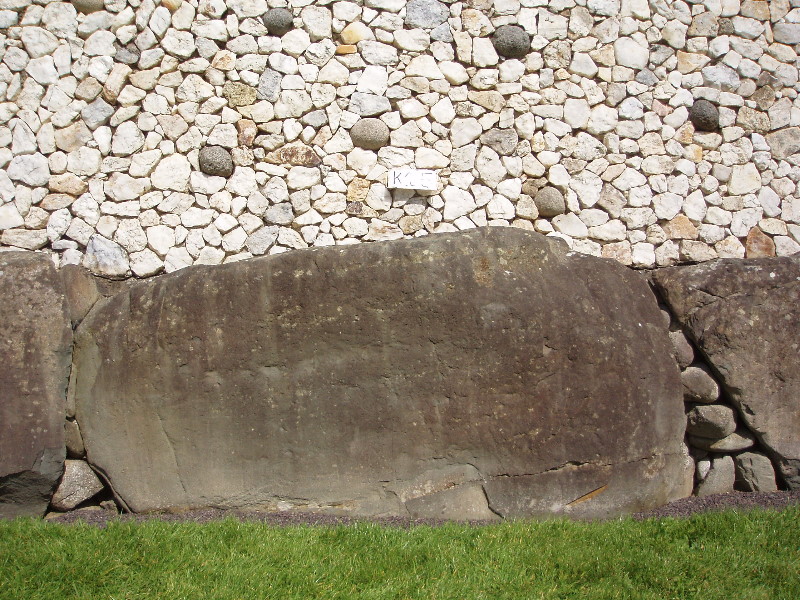
Newgrange Kerbstone K15
It is one of the 97 kerbstones numbered in Professor Michael J. O'Kelly's record of the monument. Walking clockwise from the entrance stone (K1), K15 is fourteen stones away from the entrance.
 Newgrange Kerbstone K15
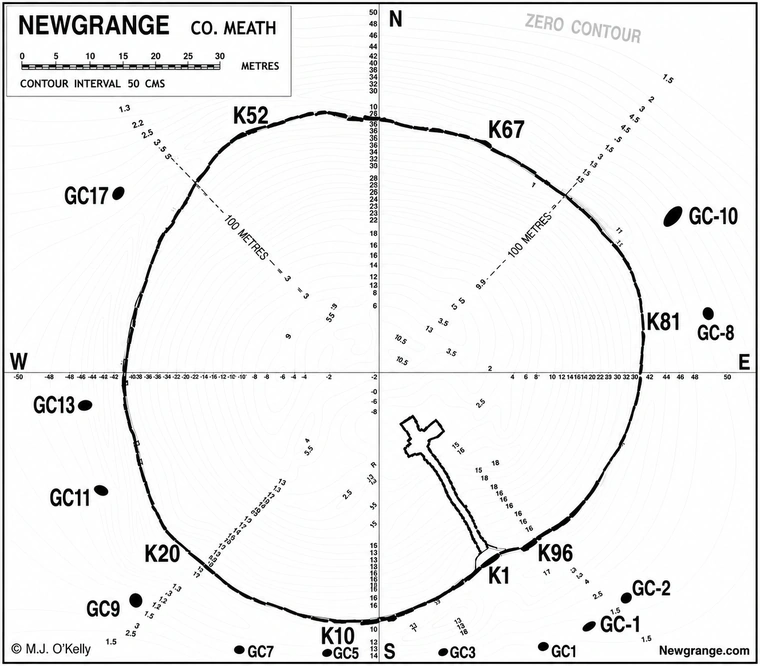 Plan of Newgrange Mound adapted from Newgrange - Archaeology, Art and Legend
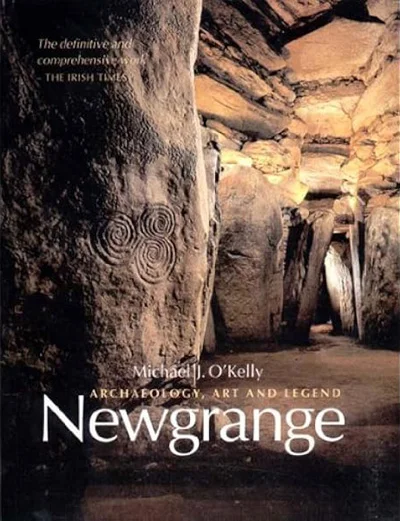
Newgrange – Archaeology, Art and Legend
 Newgrange – Archaeology, Art and Legend
by Professor Michael J. O'Kelly and Claire O'Kelly is the definitive archaeological study of Newgrange and one of the most important books ever published on an Irish prehistoric monument.
Newgrange – Archaeology, Art and Legend
by Professor Michael J. O'Kelly and Claire O'Kelly is the definitive archaeological study of Newgrange and one of the most important books ever published on an Irish prehistoric monument.
Based on Professor Michael J. O'Kelly's excavations between 1962 and 1975, the book explains the construction, chronology, megalithic art and winter solstice alignment of Newgrange. O'Kelly also describes the excavation, interpretation and restoration of the great passage tomb using detailed archaeological records and architectural analysis.
Richly illustrated throughout, the volume includes the important contribution of Claire O'Kelly, who collaborated closely in the excavation and recording of the site from its earliest seasons.
First published in 1982, with a paperback edition in 1988, the book remains an essential reference for anyone interested in the archaeology, megalithic art and wider significance of Newgrange and the Boyne Valley.
Purchase at Amazon.com or Amazon.co.uk
Newgrange | Brú na Bóinne
Geologically, most Newgrange kerbstones are greywacke from coastal quarries north-east of the site. Granite boulders in the entrance façade came from separate sources, adding colour contrast to the white quartz revetment.
The kerb acted as a retaining collar for the cairn; when it failed outward, stones tipped and art faces were buried until twentieth-century excavation. Fallen kerbstones found face-down on the old ground surface suggest relatively early collapse.
Irish folklore later attached the mound to the Tuatha Dé Danann and the god Dagda, blending prehistoric fact with medieval myth in stories still told on tours.
Detailed pages for individual kerbstones help visitors prepare for what to look for on a circuit of the mound: named art on some stones, plain greywacke on others, and always the scale of the engineering beneath the grass-covered cairn.