Newgrange Kerbstone K19
It is one of the 97 kerbstones numbered in Professor Michael J. O'Kelly's record of the monument. Walking clockwise from the entrance stone (K1), K19 is eighteen stones away from the entrance.
 Newgrange Kerbstone K19
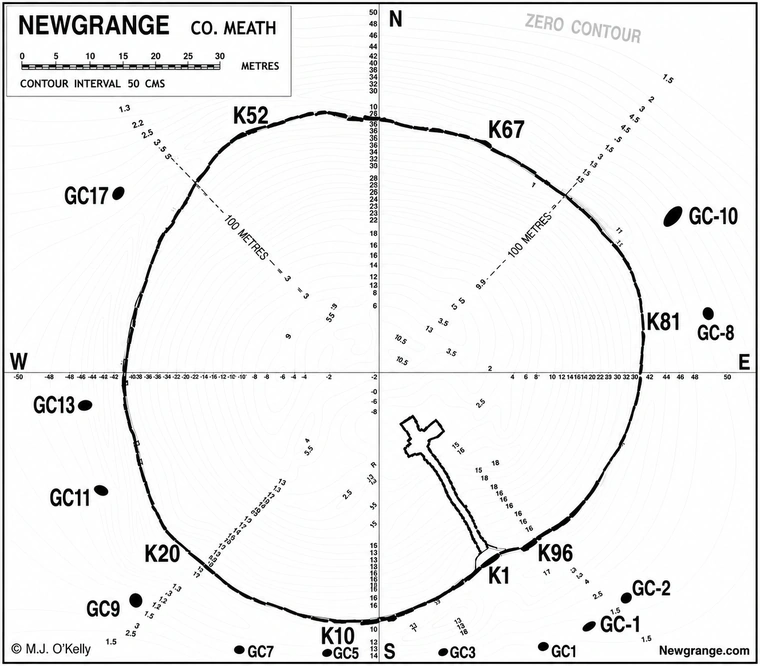 Plan of Newgrange Mound adapted from Newgrange - Archaeology, Art and Legend
Newgrange – Archaeology, Art and Legend
 Newgrange – Archaeology, Art and Legend
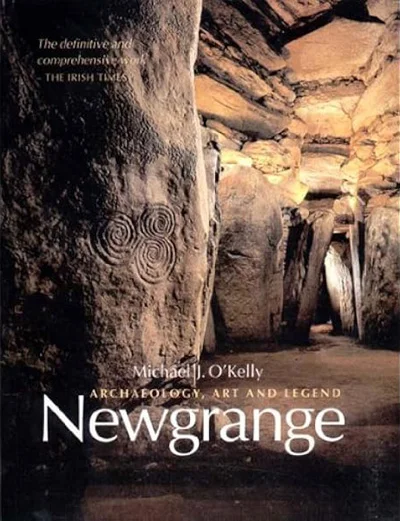
by Professor Michael J. O'Kelly and Claire O'Kelly is the definitive archaeological study of Newgrange and one of the most important books ever published on an Irish prehistoric monument.
Newgrange – Archaeology, Art and Legend
by Professor Michael J. O'Kelly and Claire O'Kelly is the definitive archaeological study of Newgrange and one of the most important books ever published on an Irish prehistoric monument.
Based on Professor Michael J. O'Kelly's excavations between 1962 and 1975, the book explains the construction, chronology, megalithic art and winter solstice alignment of Newgrange. O'Kelly also describes the excavation, interpretation and restoration of the great passage tomb using detailed archaeological records and architectural analysis.
Richly illustrated throughout, the volume includes the important contribution of Claire O'Kelly, who collaborated closely in the excavation and recording of the site from its earliest seasons.
First published in 1982, with a paperback edition in 1988, the book remains an essential reference for anyone interested in the archaeology, megalithic art and wider significance of Newgrange and the Boyne Valley.
Purchase at Amazon.com or Amazon.co.uk
Newgrange | Brú na Bóinne
Newgrange belongs to the Boyne Valley passage-tomb tradition, part of a wider Atlantic façade culture that stretches from Iberia to Orkney. Its art shares motifs with Knowth, Dowth, Loughcrew and monuments in Brittany, yet the sparse kerb decoration at Newgrange contrasts with the densely carved kerb at Knowth.
The solstice light show is unique among Irish passage tombs in its precision and publicity, but astronomical orientations may also be encoded in kerb art and in the Great Circle of standing stones that surrounds the mound.
Excavation showed that Newgrange was enlarged from an earlier turf mound, with kerbstones laid before the final cairn slip was added. Hidden carving on inner faces of several kerbstones confirms that the ring was complete before the mound reached its present size.
Greywacke, the sandstone used for most kerbstones, weathers to a good carving surface. Geraldine Stout notes in Newgrange and the Bend of the Boyne that organised quarrying must have supplied the enormous quantity of stone used in the monument.