Newgrange Kerbstone K20
It is one of the 97 kerbstones numbered in Professor Michael J. O'Kelly's record of the monument. Walking clockwise from the entrance stone (K1), K20 is nineteen stones away from the entrance.
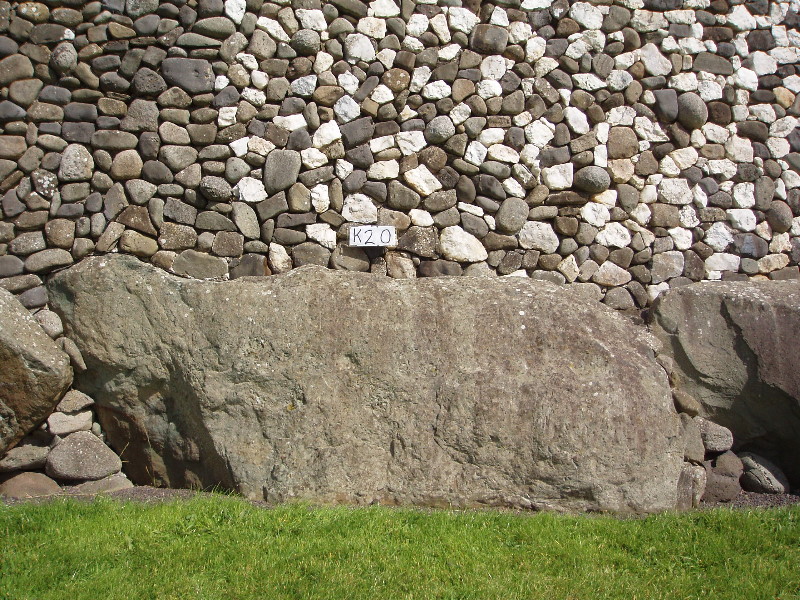 Newgrange Kerbstone K20
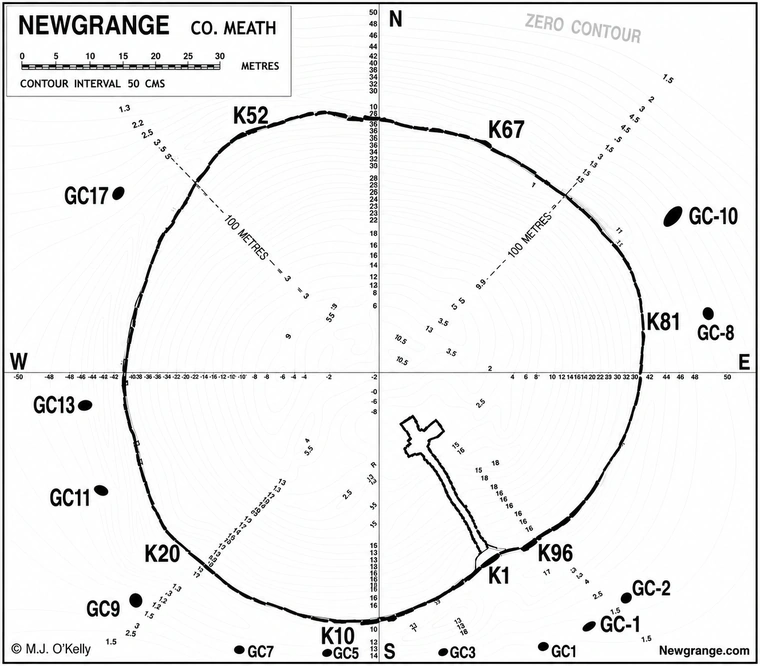 Plan of Newgrange Mound adapted from Newgrange - Archaeology, Art and Legend
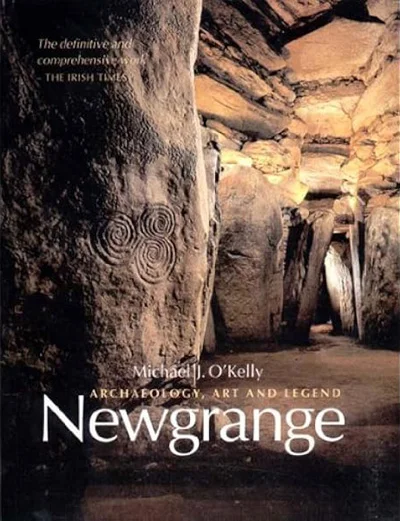
Newgrange – Archaeology, Art and Legend
 Newgrange – Archaeology, Art and Legend
by Professor Michael J. O'Kelly and Claire O'Kelly is the definitive archaeological study of Newgrange and one of the most important books ever published on an Irish prehistoric monument.
Newgrange – Archaeology, Art and Legend
by Professor Michael J. O'Kelly and Claire O'Kelly is the definitive archaeological study of Newgrange and one of the most important books ever published on an Irish prehistoric monument.
Based on Professor Michael J. O'Kelly's excavations between 1962 and 1975, the book explains the construction, chronology, megalithic art and winter solstice alignment of Newgrange. O'Kelly also describes the excavation, interpretation and restoration of the great passage tomb using detailed archaeological records and architectural analysis.
Richly illustrated throughout, the volume includes the important contribution of Claire O'Kelly, who collaborated closely in the excavation and recording of the site from its earliest seasons.
First published in 1982, with a paperback edition in 1988, the book remains an essential reference for anyone interested in the archaeology, megalithic art and wider significance of Newgrange and the Boyne Valley.
Purchase at Amazon.com or Amazon.co.uk
Newgrange | Brú na Bóinne
Brú na Bóinne takes its name from the River Boyne, which curves through one of Ireland's richest archaeological landscapes. Newgrange sits on the north bank, visible for kilometres across the flood plain.
The passage tomb's cruciform plan, with recesses off a central chamber, is mirrored in art on chamber orthostats and on kerbstones such as K52 and K67, positioned on solstice and north-south axes.
Since the 1960s excavations, Newgrange has been partly reconstructed: quartz and granite at the entrance, a concrete retaining wall behind the entrance kerb, and a white wall visible from the visitor centre. Debate continues over how much of the façade is original.
Despite reconstruction, the kerbstones remain authentic Neolithic fabric. Numbering them K1 to K97, as in O'Kelly's publication, allows each stone to be identified in photographs, drawings and conservation records.